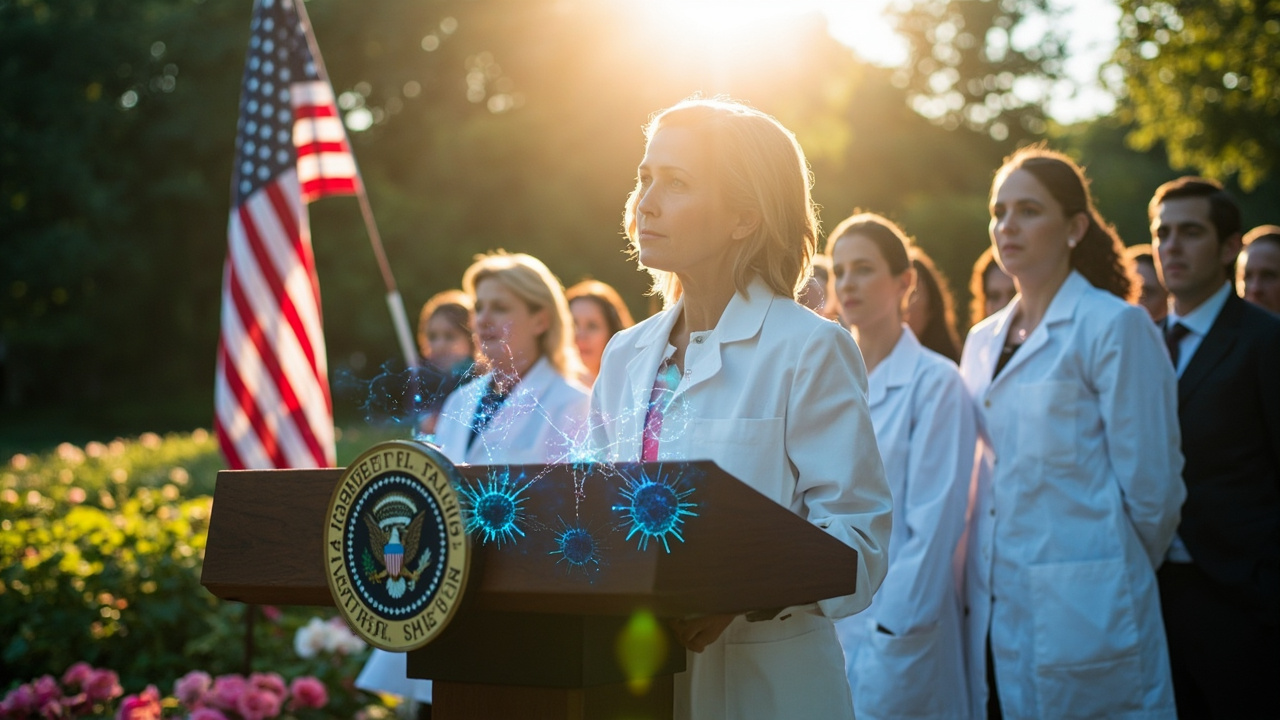
TL;DR: President Donald J. Trump signed an executive order on October 19, 2026, creating a Women’s Health Division inside the National Institutes of Health and a White House Women’s Health Task Force.
President Donald J. Trump signed a women’s-health executive order on Monday, October 19, 2026, during a Rose Garden event introduced by first lady Melania Trump, directing new federal research and coordination structures for conditions affecting women and girls. According to The Hill, the president credited the first lady with pushing the issue, while the White House published the full order under the title Advancing Women’s Health to Improve Outcomes in All Phases of Life.
The directive has two central institutional moves. First, it instructs the Secretary of Health and Human Services, acting through the Director of the National Institutes of Health, to establish a Women’s Health Division within an appropriate institute or center within 90 days. Second, it creates a White House Women’s Health Task Force intended to coordinate federal activity from infancy and adolescence through pregnancy, midlife, menopause and aging.
New NIH division and 90-day deadline
The order places the HHS secretary at the center of implementation. According to the White House order text, the secretary, acting through the NIH director, shall establish the Women’s Health Division within 90 days.
The division is to work in coordination with the NIH Office of Research on Women’s Health. According to HHS, that collaboration will focus on conditions that uniquely or disproportionately affect women, stronger accountability in federally funded research, and faster translation of discoveries into prevention, diagnosis, treatment and clinical care.
The order lists seven responsibilities for the division. Those include expanding scientific review of understudied conditions, advancing and coordinating research including replication studies, promoting innovation and advanced research technologies, strengthening interdisciplinary collaboration, improving data-collection and research methods, developing accountability for grant recipients, and facilitating translation into clinical and public-health practice.
A central accountability provision concerns sex as a biological variable. According to Fierce Healthcare, the division will develop accountability for grant recipients to enhance adherence to the NIH policy requiring research to account for sex as a biological variable.
White House task force leadership and membership
The second structure is the White House Women’s Health Task Force. It is co-chaired by the HHS secretary and the Assistant to the President and Chief of Staff, identified by HHS as Secretary Robert F. Kennedy Jr. and White House Chief of Staff Susie Wiles.
According to the White House order text, additional members include the Secretary of War, the Secretary of Agriculture, the Secretary of Labor, the Secretary of Education, the Secretary of Veterans Affairs, the Administrator of the Environmental Protection Agency, the Commissioner of Food and Drugs, the Director of the Centers for Disease Control and Prevention, the Director of the National Institutes of Health, the Director of the Advanced Research Projects Agency for Health, and the Administrator of the Centers for Medicare and Medicaid Services. The co-chairs may invite other administration officials to participate.
HHS is assigned to provide funding for administrative costs. The co-chairs may hold public hearings, meetings, roundtables and similar events, and may receive expert input from leaders in women’s health, technology, academia, the private sector, philanthropy and other relevant fields, according to the White House order text.
Life-stage approach and disease priorities
The policy statement frames women’s health as spanning infancy, childhood and adolescence through pregnancy, midlife, menopause and aging. It calls for timely, stage-specific prevention, diagnosis, treatment and care, supported by coordinated federal leadership, bolstered scientific investment and accelerated translation of research into clinical and community practice.
The order states that many diseases and conditions that disproportionately or uniquely affect women have not received the same level of research, clinical attention and treatment as other conditions. It lists cardiovascular and heart disease, cancer, stroke, Alzheimer’s disease, autoimmune and inflammatory conditions, osteoporosis, mental health, chronic pain, endometriosis, fibroids, polyendocrine metabolic ovary syndrome, infertility, maternal health, menopause, neurological disorders and aging as areas where more research is needed.
According to HHS, the new NIH division will advance work on cardiovascular disease, cancer, autoimmune and inflammatory conditions, chronic pain, endometriosis, fibroids, polyendocrine metabolic ovary syndrome (PMOS), infertility, maternal health, menopause, Alzheimer’s disease, osteoporosis and other life-course conditions. The division is also directed to promote advanced research technologies and personalized medicine, strengthen interdisciplinary research, improve understanding of sex-specific outcomes, increase inclusion of women and girls in clinical trials, and translate discoveries into practice.
What officials said at the announcement
Melania Trump introduced the order at the White House event. According to The Hill, she said the measure “establishes a new standard for women’s health in America.”
In the same report, she described the intended scope across life stages: “Our mission must serve women at every stage of life, from young girls just starting out, to mothers dealing with a complex range of responsibilities, to mature women who deserve to have vitality, dignity and independence.”
President Trump said the initiative would pursue understudied diseases affecting women and support earlier diagnosis and improved treatment using the best available science. According to The Hill, the first meeting of the task force was scheduled for later Monday.
HHS Secretary Robert F. Kennedy Jr. said the new division would confront longstanding questions with rigorous science and move discoveries toward better care. NIH Director Jay Bhattacharya said women deserve strong research to help them and their doctors address health questions at every stage of life, while CDC Director Dr. Erica Schwartz said women’s needs, experiences and voices should guide care at every stage of life, according to HHS.
Prior HHS actions cited as context
The announcement was presented as building on HHS actions since January 2025 to move from treating conditions in isolation toward a whole-person approach grounded in prevention, root causes, rigorous science and informed decision-making, according to HHS.
Those cited actions include expanded NIH women’s-health research initiatives focused on midlife health, maternal health, autoimmune disease, endometriosis, infertility, sex differences, hormone health and other conditions affecting women.
Menopause policy featured prominently in the background material. According to HHS, the Food and Drug Administration initiated removal of broad boxed warnings from hormone replacement therapy products, while HHS partnered with the American Urological Association to promote evidence-based use of local estrogen therapy for postmenopausal women.
HHS also cited two drug approvals to expand options for menopausal symptoms. The first was a generic version of Premarin, described as the first such approval in more than 30 years and expected to improve affordability and access while maintaining the same quality, safety and effectiveness as the brand-name drug. The second was approval of a non-hormonal treatment for moderate to severe vasomotor symptoms, such as hot flashes, associated with menopause.
Other cited efforts include a Breast Cancer Screening and Diagnostic Follow-up Initiative, described as a collaborative plus a national analysis using nationally representative inpatient and outpatient data on screening patterns, diagnostic follow-up, modality use, timeliness and outcomes among midlife and menopausal women. HHS also cited an Infertility Initiative to analyze nationally representative health data and convene a quality-improvement collaborative.
What happens next
The operative deadlines and next steps are administrative rather than clinical. The NIH division must be established within 90 days of October 19, 2026, inside an appropriate institute or center. The task force is charged with ensuring a comprehensive federal approach and supporting policy and regulatory reforms for stage-specific prevention, diagnosis, treatment and care.
Specific task-force functions listed in the order include advancing women’s-health science through strengthened research and initiatives, advancing patient-centered care through education and research into coordinated, preventive and woman-centered care, and accelerating evidence-based strategies to move research into policies, evidence-based medicine and best clinical practices, according to Fierce Healthcare and the White House order text.
No new research funding amount, grant program, product approval or clinical guideline was announced as part of the October 19 order itself in the materials reviewed. Readers seeking operational detail will need to watch for the HHS implementation notice establishing the division, task-force meeting summaries, and any subsequent NIH guidance on grant accountability and trial inclusion.
Sources referenced
- President Trump Signs Historic Executive Order to Advance Women’s Health, Championed by First Lady Melania Trump | HHS.gov (https://www.hhs.gov/press-room/trump-flotus-womens-health-executive-order-new-nih-division.html)
- Advancing Women's Health to Improve Outcomes in All Phases of Life – The White House (https://www.whitehouse.gov/presidential-actions/2026/10/advancing-womens-health-to-improve-outcomes-in-all-phases-of-life/)