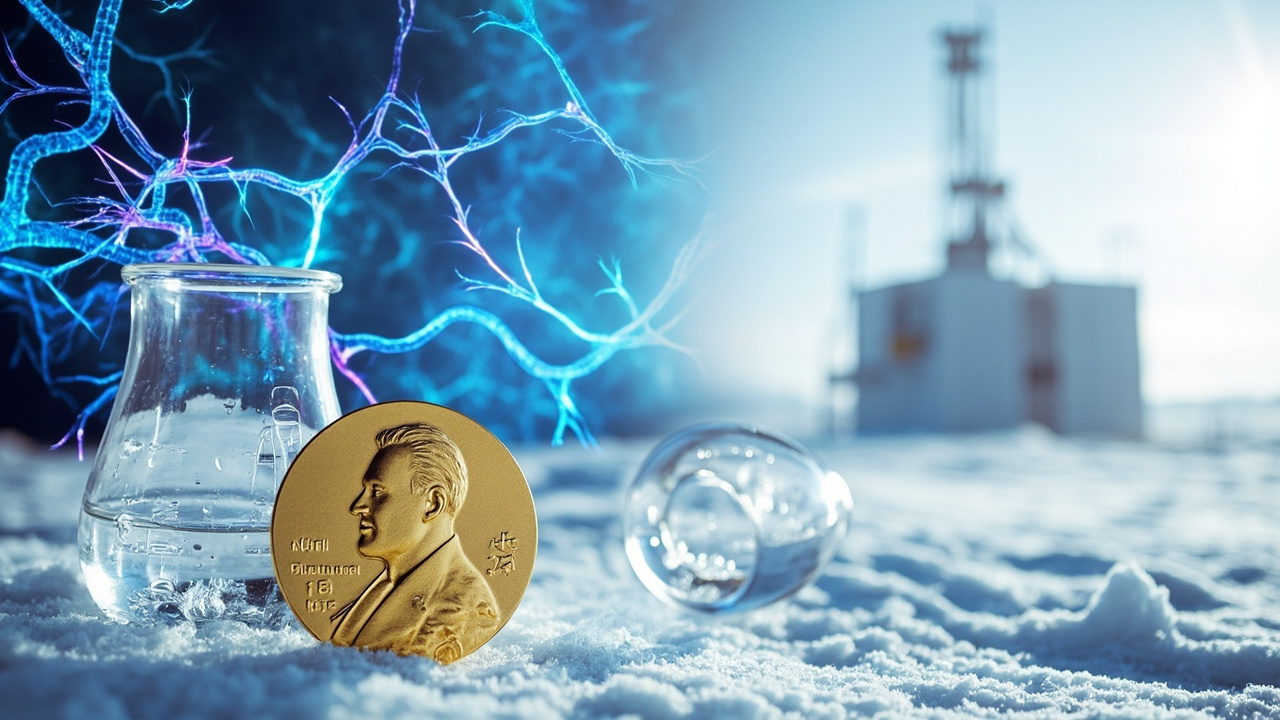
TL;DR: The 2026 Nobel Prizes announced Oct. 5-12 honored optogenetics in medicine, the IceCube neutrino observatory in physics, mirror-image chemistry, writer Anne Carson, jurist Navi Pillay, and economists Robert Hall and Michael Woodford.
2026 Nobel season closed Oct. 12 with economics prize
The annual Nobel announcements began Oct. 5 with Physiology or Medicine and concluded Monday, Oct. 12 with economics, according to PUNCH reporting gathered from the organizers' website. The 2026 laureates span medicine, physics, chemistry, literature, peace and economics, celebrating work from light control of nerve cells to international law.
The awards were established following the will of Swedish inventor and industrialist Alfred Nobel to reward contributions conferring the greatest benefit on humanity, with the economics prize established later by Sweden's central bank and first awarded in 1969, according to that same roundup and reporting in The Hindu. Winners will receive 12 million Swedish kronor per category, about $1.2 million, with the amount divided when there is more than one laureate, according to G1 and The Hindu. The award ceremonies are planned for Dec. 10, the anniversary of Alfred Nobel's death, in Sweden and Norway, a future event, according to G1.
Medicine: Light-gated channels created optogenetics
Who won and why
The Nobel Prize in Physiology or Medicine went to Karl Deisseroth, Peter Hegemann and Georg Nagel for discoveries concerning light-gated ion channels and optogenetics, according to DW's list of 2026 Nobel Prize winners. Their work established optogenetics, a technique that allows researchers to control activity of nerve cells using light, according to that PUNCH roundup.
From algae eyespot to brain switch
The story starts in the eyespot of a single-celled green alga called Chlamydomonas, according to Science News. In the early 2000s, Hegemann, then at the Max Planck Institute for Biochemistry in Martinsried, Germany, and Nagel, at the Max Planck Institute for Biophysics in Frankfurt, discovered a unique protein in the alga's eyespot, according to Science News.
When illuminated, the protein generated an electrical impulse, enabling the organism to move, according to Science News. Further research revealed that when the protein, called channelrhodopsin, was exposed to light, it opened like a pore, allowing positively charged ions to flow into a cell, according to Science News.
Building on that work, Deisseroth tested whether channelrhodopsin could activate brain cells, according to Science News. He and colleagues first inserted the gene for channelrhodopsin into cultures of rat nerve cells and found the cells reacted to light instantaneously, according to Science News. They then introduced the gene into nerve cells in brains of living mice, along with optical fibers fed through the rodents' skulls, according to Science News. By beaming blue light through the fibers, the researchers controlled movements of the rodents' whiskers, according to Science News.
The technology transformed neuroscience and helped reveal how brain circuits are disrupted, with implications for conditions such as blindness, depression and dementia, as stated during the Oct. 5 announcement by the Nobel Assembly at Karolinska Institute and reported by Science News. The technology has been used to improve vision in some patients with retinitis pigmentosa, a disease that degrades light-sensing cells in the retina, according to Science News.
Laureate posts
Deisseroth, born in 1971, is the D.H. Chen Professor and Professor of Bioengineering and Psychiatry and Behavioral Sciences at Stanford University and an Investigator at the Howard Hughes Medical Institute, according to The Hindu Visual Story Team and PUNCH. He earned his Ph.D. in 1998 and M.D. in 2000 from Stanford University, according to that team summary.
Hegemann, born in 1954, is Hertie Senior Professor of Neuroscience at Humboldt University of Berlin, according to PUNCH. Nagel, born in 1953, is Professor of Molecular Plant Physiology at the University of Würzburg, Germany, according to The Hindu Visual Story Team. Nagel earned his Ph.D. in 1988 from the University of Frankfurt, Germany, according to that summary.
Physics: Antarctic ice captured cosmic neutrinos
Halzen's IceCube vision
The Royal Swedish Academy of Sciences decided to award the Nobel Prize in Physics 2026 to Francis Halzen of the University of Wisconsin-Madison, USA, "for decisive contributions to the IceCube Neutrino Observatory and the discovery of high-energy neutrinos of astrophysical origin," according to NobelPrize.org. Halzen, born in 1944 in Tienen, Belgium, earned his Ph.D. in 1969 from KU Leuven, Belgium, according to NobelPrize.org.
Halzen first presented his vision for capturing neutrinos at the South Pole in 1988, according to NobelPrize.org. When a neutrino collides with an atomic nucleus, it produces a flash of light that can be tracked by sensors in clear glacial ice, according to NobelPrize.org. The South Pole's ice has advantages because it is free from various types of interference and the area is geologically stable, with no earthquakes, according to NobelPrize.org.
A cubic kilometre finished in 2011
Cosmic neutrinos with extremely high energies are very rare, so an enormous volume of ice is needed to observe an adequate number of collisions, according to NobelPrize.org. IceCube covers an entire cubic kilometre and was finished in 2011, according to NobelPrize.org. Researchers soon discovered the first high-energy neutrinos and, a few years later, could publish their discovery of neutrinos that must originate far outside our solar system, according to NobelPrize.org.
Neutrinos pass all the way through the Earth and through bodies without notice, and very rarely a single neutrino will interact with an atomic nucleus, which makes detection possible with the right equipment, according to NobelPrize.org. Unlike other particles, neutrinos reach Earth without changing direction or losing energy, so they can provide information not available in any other way, according to NobelPrize.org. Halzen joined the University of Wisconsin-Madison physics faculty in 1972 and became a leading figure in neutrino astronomy, according to PUNCH.
Chemistry: How chemistry chooses a mirror image
Kagan and Soai honored
The Royal Swedish Academy of Sciences decided to award the Nobel Prize in Chemistry 2026 to Henri B. Kagan of Université Paris-Sud, France, and Kenso Soai of Tokyo University of Science, Japan, "for the discovery of non-linear effects and autocatalysis in asymmetric organic synthesis," according to NobelPrize.org.
Some molecules, such as amino acids, exist as two variants that are each other's mirror image, but living organisms contain only one of these mirror images, according to NobelPrize.org. Life's chemistry is homochiral, after the Greek words for "same" and "hand," and only one mirrored variant is found in proteins in cells, according to NobelPrize.org. When chemists began experiments with reactions that can form two mirrored molecules, they always obtained equal proportions of both in test tubes, according to NobelPrize.org.
Steps in 1986, 1995 and 2003
Kagan took the first decisive step in 1986, when he discovered a new way of manipulating chemical reactions that allowed him to create a greater excess of one mirror image than previously thought possible, according to NobelPrize.org. Soai took the next step, and in 1995 a key publication describes how he designed the first chemical reaction with potential to be homochiral, according to NobelPrize.org. In 2003, he finally succeeded and presented a reaction in which only one of the two possible mirror images was formed, according to NobelPrize.org.
Their discoveries have been decisive for chemists who design reactions for manufacture of pharmaceuticals, because in development of molecules that interact with living beings only one mirror image will have the desired effect, according to NobelPrize.org.
Kagan, born in 1930 in Boulogne-Billancourt, France, earned a Ph.D. in 1960 from Collège de France and is Professor Emeritus at the then Université Paris-Sud, according to NobelPrize.org. Soai, born in 1950 in Hiroshima, Japan, earned a Ph.D. in 1979 from the University of Tokyo and is Professor Emeritus at Tokyo University of Science, according to NobelPrize.org.
Literature: Anne Carson cited for bold, inventive oeuvre
Canadian poet, essayist and translator Anne Carson won the Nobel Prize in literature for "her bold and inventive oeuvre that, in playful dialogue with the classical tradition, has created new forms for contemporary literature," according to AP News. The award was announced Thursday, Oct. 8, in Stockholm, according to AP News.
Carson, 76, was born in Toronto and is known for mixing poetry, prose and references to Greek and Roman literature, according to G1. Her production includes translations of ancient authors and works made in collaboration with musicians and dancers, according to G1.
Peace: Navi Pillay honored for international law work
Committee citation
The Norwegian Nobel Committee decided to award the Nobel Peace Prize for 2026 to Navanethem "Navi" Pillay for her efforts to promote peace and international law, according to the Nobel Peace Prize press release. The prize goes to a person who with exceptional courage and integrity has led the way toward a more comprehensive global legal order, according to that release. She was instrumental in ensuring that war crimes, crimes against humanity and genocide are prosecuted, according to that release.
Career from apartheid defense to international courts
Pillay, 85, grew up in South Africa during apartheid as a bus driver's daughter in a poor Indian section of Durban, according to the BBC. Born into a family of Indian Tamil origin under apartheid in Durban, she became a lawyer confronting structural discrimination, segregation and exclusion, according to the Nobel Peace Prize press release. Her early work included defending anti-apartheid activists including Nelson Mandela, according to that release and the BBC.
She served as a judge on the High Court in South Africa, the International Criminal Tribunal for Rwanda and the International Criminal Court, according to the Nobel Peace Prize press release. She was United Nations High Commissioner for Human Rights and, until recently, chaired the UN Independent International Commission of Inquiry on the Occupied Palestinian Territory, according to that release. She is a judge on the International Court of Justice in the case where Myanmar stands accused of genocide, according to that release.
When the International Criminal Tribunal for Rwanda established that rape and sexual violence could constitute a crime against humanity as well as genocide, her influence was a significant factor, according to that release. In the same case, she was instrumental in a separate breakthrough where, for the first time, a defendant faced charges of incitement to commit genocide purely on spreading propaganda, according to that release. She became South Africa's fifth Peace Prize winner, following Nelson Mandela and Archbishop Desmond Tutu, according to the BBC.
Economics: Hall and Woodford on stabilization policy
U.S. economists Robert E. Hall and Michael Woodford were announced Oct. 12 as winners of the 2026 Nobel Memorial Prize in Economic Sciences for work on how to smooth boom-and-bust cycles to limit inflation and unemployment, according to NPR. Hall is of Stanford University and Woodford is of Columbia University, according to NPR. They were honored for "microeconomic foundations of macroeconomic stabilisation," according to DW's list and The Hindu.
Hall concentrated on demand and how households make purchasing decisions, guided not only by current purchasing power but what they expect incomes will be in the future, according to NPR. Woodford focused on supply and how businesses set prices, where expectations are key because changing prices was historically costly, according to NPR. Because households and businesses are forward-looking, the laureates argued policymakers should communicate plans clearly to the public, according to NPR.
The importance of that work was underscored by the pandemic, which pushed millions out of work, and supply shocks that followed, driving up the cost of living, according to NPR. The prestigious award, formally known as the Sveriges Riksbank Prize in Economic Sciences in Memory of Alfred Nobel, is the final prize given out this year and is worth 12 million Swedish crowns, according to The Hindu.
Sources referenced
- Press release: Nobel Prize in Physics 2026 - NobelPrize.org (https://www.nobelprize.org/prizes/physics/2026/press-release/)
- Press release: Nobel Prize in Chemistry 2026 - NobelPrize.org (https://www.nobelprize.org/prizes/chemistry/2026/press-release/)