TL;DR: Francis Halzen of the University of Wisconsin–Madison won the 2026 Nobel Prize in Physics for his decisive contributions to the IceCube Neutrino Observatory and the discovery of high-energy neutrinos from beyond the solar system.
The Royal Swedish Academy of Sciences announced the award on October 6, 2026, honoring Halzen alone for vision and scientific leadership that made a cubic-kilometre neutrino telescope in Antarctic ice possible, according to NobelPrize.org.
A solo physics prize for a cubic kilometre of ice
The Academy awarded the 2026 Nobel Prize in Physics to Francis Halzen, University of Wisconsin–Madison, USA, for decisive contributions to the IceCube Neutrino Observatory and the discovery of high-energy neutrinos of astrophysical origin, according to NobelPrize.org.
Halzen, born in 1944 in Tienen, Belgium, earned a PhD in 1969 from KU Leuven, Belgium, and serves as professor at the University of Wisconsin–Madison, according to NobelPrize.org.
Halzen learned of the honor while in Italy and joined the Stockholm announcement by telephone, saying it was a great surprise and that he obviously had not expected it, according to Ars Technica. He stressed that the work reflected a large collaboration with other researchers, according to Ars Technica.
The prize amount is 12 million Swedish kronor, according to NobelPrize.org. Mark Pearce, chair of the Nobel Committee for Physics, said Halzen had led an international team of researchers and engineers that provided a fantastic instrument and that his tenacity and scientific vision had paved the way for a new kind of astronomy, according to NobelPrize.org.
Halzen said the recognition belonged to courageous colleagues who joined the project when no respectable conservative physicist would have joined, adding that many talented people did join and that was why he was there, according to Ars Technica.
What IceCube is
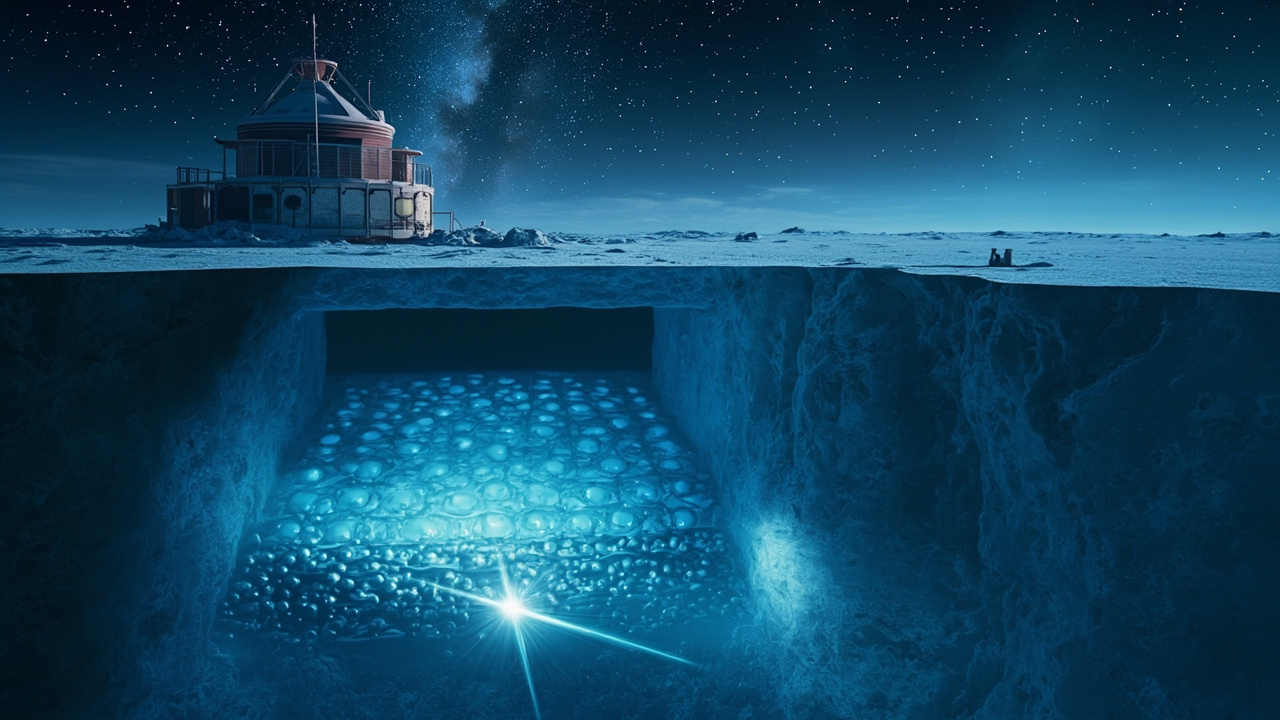
IceCube is a cubic kilometre of Antarctic ice equipped with light sensors that records flashes created when rare neutrinos strike atomic nuclei, according to NobelPrize.org.
The detector uses more than 5,000 light sensors spread across a cubic kilometre of ice about two kilometres below the surface at the South Pole, according to CERN. The U.S. National Science Foundation described thousands of digital detectors placed more than two kilometers deep in crystal-clear ice, an arrangement designed to detect many neutrinos and determine their arrival directions, according to the NSF.
The South Pole ice was selected because it is clear, dark at depth, free from several types of interference, low in radioactive substances, geologically stable with no earthquakes, and served by an existing research station with transport and working facilities, according to NobelPrize.org and the Royal Swedish Academy of Sciences background material.
Scientists had long placed neutrino experiments deep underground to reduce noisy interference from other sources, while several physicists in the 1980s had proposed water as a detection medium for neutrinos from space, according to Ars Technica. Halzen’s approach instead used naturally occurring ice rather than water, according to the Royal Swedish Academy of Sciences background material.
When a neutrino collides with an atomic nucleus in the ice, it produces a charged particle that travels in the original neutrino direction and emits blue light, which transparent ice allows sensors to detect and use to reconstruct direction, according to the Royal Swedish Academy of Sciences background material.
UW–Madison News called IceCube the world’s largest telescope and identified Halzen as principal investigator of the NSF-funded observatory, which is operated by an international collaboration of scientists. CERN lists IceCube as a CERN Recognized Experiment, according to CERN.
From a 1988 proposal to operations in 2011
Halzen first presented his vision for capturing neutrinos at the South Pole in 1988, according to NobelPrize.org. He developed the concept with research colleague John G. Learned, who had worked on the DUMAND project intended to capture light signals from interacting neutrinos in deep ocean water off Hawaii, and the two physicists presented the South Pole ice observatory concept at a conference in Poland in 1988, according to the Royal Swedish Academy of Sciences background material.
Halzen had been inspired in part after hearing that Soviet researchers planned to use radio receivers to capture neutrino signals in Antarctica, where a collision would cause an electric spark producing a radio wave that an antenna might capture, according to the Royal Swedish Academy of Sciences background material. He reasoned that light sensors in glacial ice could look instead for flashes of light from collisions, according to the Royal Swedish Academy of Sciences background material.
Halzen soon gained support from other researchers, and preliminary testing of sensors in ice took place a few years later, according to NobelPrize.org. The Academy’s background material dates the first attempts to lower light sensors into the glacier at the South Pole to 1992 by a group of researchers and engineers, according to the Royal Swedish Academy of Sciences background material.
The project was first proposed to the NSF in the 1990s as an unusually ambitious facility unlike any other, according to the NSF. Construction began in 2004 at the NSF Amundsen-Scott South Pole Station with support from the NSF-managed U.S. Antarctic Program, according to the NSF.
IceCube covers an entire cubic kilometre and was finished in 2011, according to NobelPrize.org. The NSF dates the start of operations to 2011, according to the NSF. The NSF said it invested over more than two decades in design, construction and ongoing operations, according to the NSF.
Halzen said the project succeeded because of UW–Madison’s research infrastructure, talented engineers at the Physical Sciences Laboratory, longtime faculty colleagues and supportive administrators, adding that it was difficult to imagine pulling it off anywhere but at UW–Madison where unconventional ideas can thrive, according to UW–Madison News.
Why ghost particles matter
Neutrinos are everywhere but do not make themselves known, passing through Earth and human bodies without notice, according to NobelPrize.org. About 100 trillion neutrinos pass through the human body every second, according to CERN. Ars Technica reported that people are bombarded every second by millions of these tiny particles, which pass through without notice, a property that led Isaac Asimov to call them ghost particles.
Neutrinos have no electric charge and almost no mass, although physicists once believed they had no mass at all before learning they carry a tiny amount, according to the Royal Swedish Academy of Sciences background material and Ars Technica. They are the most abundant subatomic particle in the universe but very rarely interact with matter, according to Ars Technica.
Very rarely, a single neutrino interacts with an atomic nucleus, making detection possible with the right equipment, according to NobelPrize.org. That low interaction rate makes neutrinos extremely difficult to detect, according to Ars Technica.
Because they are so light, neutrinos can escape unimpeded and largely unchanged by collisions with other matter, allowing them to carry clues about distant systems, according to Ars Technica. Unlike other particles, high-energy neutrinos reach Earth without changing direction or losing energy, providing information not available in another way, according to NobelPrize.org.
Astronomers combine neutrino data with telescopes across the electromagnetic spectrum and gravitational waves in what researchers call multimessenger astronomy, according to Ars Technica.
The cosmos contains natural particle accelerators that fire out particles with energies up to a million times more than can be achieved in laboratories on Earth, according to NobelPrize.org. Much about those sources remains mysterious, including what they are, where they are and what processes operate inside them, according to NobelPrize.org.
Because processes that accelerate protons to high energies also give rise to high-energy neutrinos, neutrinos can provide crucial clues about cosmic particle accelerators, according to the Royal Swedish Academy of Sciences background material. Researchers can distinguish huge-energy neutrinos from lower-energy neutrinos produced by radioactive decay, the Sun, or cosmic rays striking Earth’s atmosphere, according to the Royal Swedish Academy of Sciences background material. Neutrinos that do not originate nearby must come from far away, perhaps from exploding stars or distant active galaxies, according to the Royal Swedish Academy of Sciences background material.
Cosmic neutrinos found, then traced
Researchers soon discovered the first high-energy neutrinos after completion and, a few years later, published their discovery of neutrinos that must originate far outside the solar system, according to NobelPrize.org.
Two years after operations began, IceCube published findings showing it had detected the highest-energy neutrinos ever observed, according to the NSF. Those neutrinos carried more than a million times the energy of those previously detected and provided the first evidence that neutrinos might regularly pass through Earth from distant high-energy sources outside the solar system, according to the NSF.
In 2018, analysis of IceCube data produced definitive evidence of neutrinos coming from a supermassive black hole in another galaxy, according to the NSF. In 2023, IceCube produced the first-ever neutrino-based image of the Milky Way, according to the NSF.
Many results relied on NSF high-performance computing facilities used to process large IceCube data volumes and run simulations that helped interpret measurements with greater accuracy, according to the NSF.
The Academy said neutrino interactions continuously collected by IceCube will give researchers new knowledge about violent settings where high-energy neutrinos are created and could reveal previously unknown cosmic phenomena, according to NobelPrize.org.
A long neutrino history
Wolfgang Pauli first proposed neutrinos in a 1930 letter to colleagues to explain missing energy in radioactive beta decay in atomic nuclei, and Enrico Fermi later dubbed the hypothetical particle a neutrino, according to Ars Technica.
Clyde Cowan and Frederick Reines first observed the particles in 1956 using fusion reactions in nuclear power plants that proliferated after World War II, according to Ars Technica. Ten years later, physicists detected the first solar neutrinos, work that brought Ray Davis Jr. and Masatoshi Koshiba a share of the 2002 Nobel Prize in Physics alongside Riccardo Giacconi, honored for pioneering contributions to astrophysics leading to cosmic X-ray sources, according to Ars Technica.
Detectors found far fewer solar neutrinos than theory predicted, a puzzle called the solar neutrino problem, according to Ars Technica. Physicists discovered a second flavor, the muon neutrino, in 1962, followed by the tau neutrino in 2000, according to Ars Technica.
Observations by Japan’s Super-Kamiokande collaboration in 1998 supported the idea that neutrinos can switch from one flavor to another, and scientists at the Sudbury Neutrino Observatory announced in 2002 that missing solar electron neutrinos had changed into a different flavor during the journey between the Sun and Earth, according to Ars Technica. Arthur B. McDonald of SNO and Takaaki Kajita of Super-K shared the 2015 Nobel Prize in Physics for those breakthroughs, according to Ars Technica.
Reaction to the 2026 choice
Danielle Norcini, a particle physicist at Johns Hopkins University, said she was shocked and absolutely delighted that Halzen was awarded the Nobel, calling him the scientific visionary and driving force behind IceCube, according to Ars Technica. She said the experiment transformed understanding of the universe by detecting the first high-energy neutrinos from beyond the galaxy and opening a new field of neutrino astronomy, while noting that hundreds of scientists, engineers and collaborators built the achievement, according to Ars Technica.
CERN Director-General Mark Thomson said it was fantastic to see astroparticle physics recognized by the Nobel Committee and that Halzen’s vision and leadership had been fundamental to IceCube’s success as a CERN Recognized Experiment that transformed understanding of astrophysical high-energy neutrinos, according to CERN.
Brian Stone, performing the duties of NSF Director, said foundational science requires extraordinary grit from engineers, instrument builders and field crews who constructed and continue to operate a massive observatory beneath Antarctic ice, adding that NSF was proud to support the IceCube collaboration and personnel in the U.S. Antarctic Program who turned the vision into reality, according to the NSF.
Sources referenced
- Press release: Nobel Prize in Physics 2026 - NobelPrize.org (https://www.nobelprize.org/prizes/physics/2026/press-release/)
- Neutrino physicist wins 2026 Nobel Physics Prize - Ars Technica (https://arstechnica.com/science/2026/10/neutrino-physicist-wins-2026-nobel-physics-prize/)