TL;DR: Alibaba said on September 22, 2026, at its Apsara Conference in Hangzhou that its Qwen 4 model is in training, future Qwen 4.5 and Qwen 5 models are projected at 5 trillion to 10 trillion parameters, and its T-Head unit unveiled the Zhenwu V900 AI accelerator for mass production in the first quarter of 2027.
Alibaba framed the announcements as a full-stack roadmap covering foundation models, multimodal systems, proprietary chips, cloud infrastructure and phone agents, according to Alibaba Cloud. Chairman Joe Tsai said the theme for the year was “Intelligence Goes Beyond,” describing the objective as moving AI from technological breakthroughs toward value creation. Chief Executive Eddie Wu said machine thinking remained less than 3% of human thinking and still had what he called enormous growth runway, and set a target for Alibaba Cloud-operated global data-center capacity to surpass 20 gigawatts by 2032.
Announcement at Hangzhou flagship event
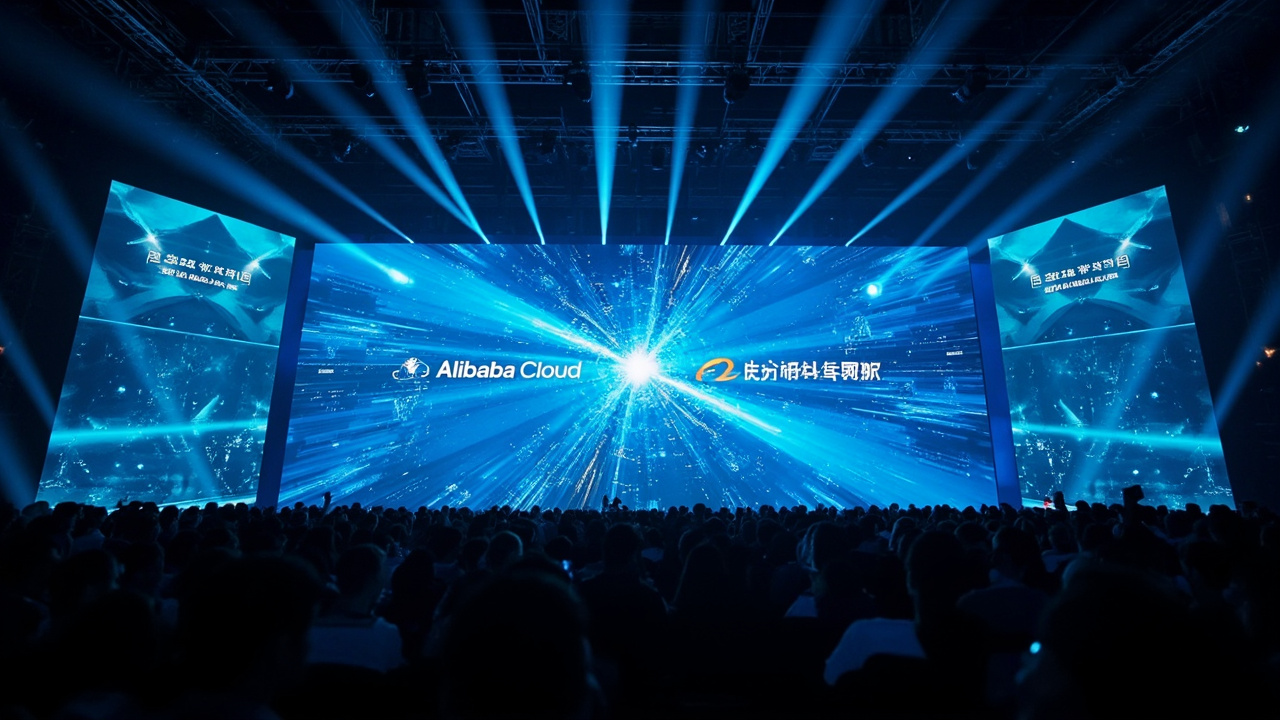
Alibaba Cloud’s annual flagship technology conference, the Apsara Conference, opened on Sept. 22, 2026, in Hangzhou, according to Alibaba Cloud. Group CEO Eddie Wu delivered the keynote outlining the company’s view of what Alibaba termed the Machine Intelligence era and its strategic roadmap.
Reuters reported that Alibaba shares rose 5% after the announcements, while CNBC reported a jump of around 3% in Hong Kong on Tuesday. Reuters described the event as underscoring Alibaba’s push to build every layer of its AI business, from models to processors to cloud capacity.
The conference was scheduled to run through Thursday, according to the South China Morning Post. Alibaba said updates spanned Qwen foundation models and multimodal models, new proprietary AI chips, a purpose-built agentic cloud and an AI agent platform for mobile phones.
Qwen 4 in training, 5 trillion to 10 trillion parameters projected
Alibaba revealed that its next-generation model, Qwen 4, is currently in training, according to Alibaba Cloud. The company also announced a roadmap for upcoming Qwen 4.5 and Qwen 5 series models projected to scale up to 5 to 10 trillion parameters.
Reuters reported that the planned scale would be up to four times larger than the company’s flagship model. The South China Morning Post described the future system as teased at up to 10 trillion parameters alongside what Alibaba called China’s most powerful AI chip.
CNBC noted that Alibaba also said its next-generation Qwen 4 model is in training and outlined plans for future Qwen 4.5 and Qwen 5 model series. The disclosures position the Qwen family as the foundation-model pillar of the broader infrastructure and agent announcements made the same day.
Self-improvement tests cited for Qwen3.8-Max
Alibaba said it had made progress in recursive self-improvement driven by empirical feedback, according to Alibaba Cloud. Over one month of fully automated runs covering pipeline design, data validation, iterative experimentation and error diagnosis, Qwen3.8-Max completed 33 iterative cycles.
Through autonomous training optimization and post-training techniques, the updated Qwen3.8-Max increased its Artificial Analysis score from 40 to 45, according to Alibaba Cloud. TNGlobal, reporting the same company figures, noted that the numbers were reported by Alibaba and were not independent benchmark results.
In a chip-design experiment, the model worked through more than 60 hours of self-improvement across the full design lifecycle and made more than 10,000 electronic design automation tool calls to produce production-grade chip bus modules, according to Alibaba Cloud. That work reduced chip area by 42% with zero compromise in performance, the company said.
Zhenwu V900 chip claims triple predecessor performance
T-Head, Alibaba’s chip design unit, unveiled the Zhenwu V900, its latest processor for AI training and inference, according to Alibaba Cloud. The company said the accelerator offers high-capacity memory and robust inter-chip bandwidth for demanding AI workloads.
The Zhenwu V900 delivers three times the performance of its predecessor, the Zhenwu M890 released in May, according to Alibaba Cloud. CNBC likewise reported that the new chip delivers three times the performance of the M890 released in May.
Alibaba listed 216 GB of GPU memory and 1,200 GB per second of inter-chip bandwidth for the new accelerator, according to Alibaba Cloud. The processor includes native support across multiple data precisions, including FP8 and FP4, and is intended to reduce inference costs while increasing compute density.
Reuters described the processor as what Alibaba called China’s most powerful AI chip. Reuters also reported that the launch comes as Chinese technology companies develop domestic alternatives to Nvidia processors amid tightening U.S. export curbs.
Mass production timetable and existing customers
Alibaba plans mass production and commercial availability of the Zhenwu V900 in the first quarter of 2027, according to TNGlobal and CNBC. CNBC reported that the new Zhenwu AI chip is scheduled for mass production and commercial release in that quarter.
Existing Zhenwu chips are already used by more than 650 customers across industries including automotive, finance, energy and manufacturing, according to CNBC. TNGlobal listed automotive, finance, large language models, embodied intelligence, energy and manufacturing among the sectors using Zhenwu processors.
The group also outlined new Yitian processors for agentic workloads, according to TNGlobal. The Yitian 720 and Yitian 730 are scheduled for 2027, with the latter based on T-Head’s own microarchitecture.
20-gigawatt data-center target for 2032
Wu said the target is for global data-center capacity operated by Alibaba Cloud to surpass 20 gigawatts by 2032, according to Alibaba Cloud. He linked the figure to rising demand for AI compute as machine intelligence expands.
CNBC reported that Alibaba aims to operate more than 20 gigawatts of global data-center capacity by 2032 as part of a broader roadmap spanning chips, cloud infrastructure and models. TNGlobal emphasized that the 20-gigawatt figure is a future capacity target rather than currently deployed capacity.
The infrastructure discussion came alongside moves by other technology groups, according to CNBC. Earlier in September, Nvidia outlined plans to work with Australian partners to support up to 2 gigawatts of AI infrastructure in that country by 2027, while Meta in July unveiled plans for a 1-gigawatt facility in Alberta expected to cost about $9 billion and take up to three years to complete.
Multimodal releases span translation, audio and images
Alibaba introduced multimodal updates spanning speech, audio and vision, according to Alibaba Cloud. The company debuted Qwen3.8-LiveTranslate, a simultaneous interpretation model intended to improve translation fidelity, fluency and brevity.
The translation model reduces latency, measured as LAAL, nearly 20% from 2.8 to 2.3 seconds for real-time translation, according to Alibaba Cloud. The company presented the change as producing a smoother and more responsive experience.
For audio, Alibaba unveiled Qwen-Audio-3.1-TTS-Next, a next-generation audio generation model capable of creating complete cinematic soundscapes by blending dialogue and ambient sounds at once from a text script, according to Alibaba Cloud. The company described it as designed for audiobooks, film and television, podcasts and games. The updated speech suite also includes Qwen-Audio-3.1-ASR for automatic speech recognition, Qwen-Audio-3.1-TTS for text-to-speech and Qwen-Audio-3.1-Realtime for real-time interaction.
Qwen-Image 3.1, an image-generation model optimized for creative design and e-commerce marketing, is set to launch later this year, according to Alibaba Cloud. The company said it cuts visual design turnaround from hours to seconds and offers native transparent-background generation and image-editing capabilities.
Agents, phones and agentic cloud architecture
Alibaba said it launched Qwen Intelligence, a business-facing full-stack agentic solution optimized for smartphones, according to Alibaba Cloud. It provides phone makers with access to a Qwen-powered agent platform to support next-generation AI phones that handle complex, cross-app tasks reliably.
To standardize world-model evaluation, Alibaba Token Hub, alongside academic and industry partners, introduced a six-tier capability framework and launched the Happyworld Arena benchmarking platform, according to Alibaba Cloud. The platform spans video generation, embodied AI and spatial reconstruction.
Alibaba Cloud described its agentic cloud strategy in three layers, according to TNGlobal: AI Native Cloud for model training and inference, Agent Native Cloud for enterprise deployment and security, and a Context Engine for real-time data and long-term memory. Wu compared current AI development with the early stages of electrification, with CNBC quoting his remark that AI coding is simply the light bulb of the machine intelligence era.
Huawei, Alibaba’s domestic peer, also unveiled new AI infrastructure the prior week that it said can scale to as many as one million processors, according to CNBC.
Sources referenced
- Alibaba Unveils Roadmap on Full-Stack AI Strategy from Chips, Cloud Infrastructure, Models to Agents - Alibaba Cloud (https://www.alibabacloud.com/en/press-room/alibaba-unveils-roadmap-on-full-stack-ai-strategy?_p_lc=1)
- Alibaba shares jump as new AI chip, data center buildout plans unveiled - CNBC (https://www.cnbc.com/2026/09/22/alibaba-ai-alibabacloud-zhenwu-v900-.html)