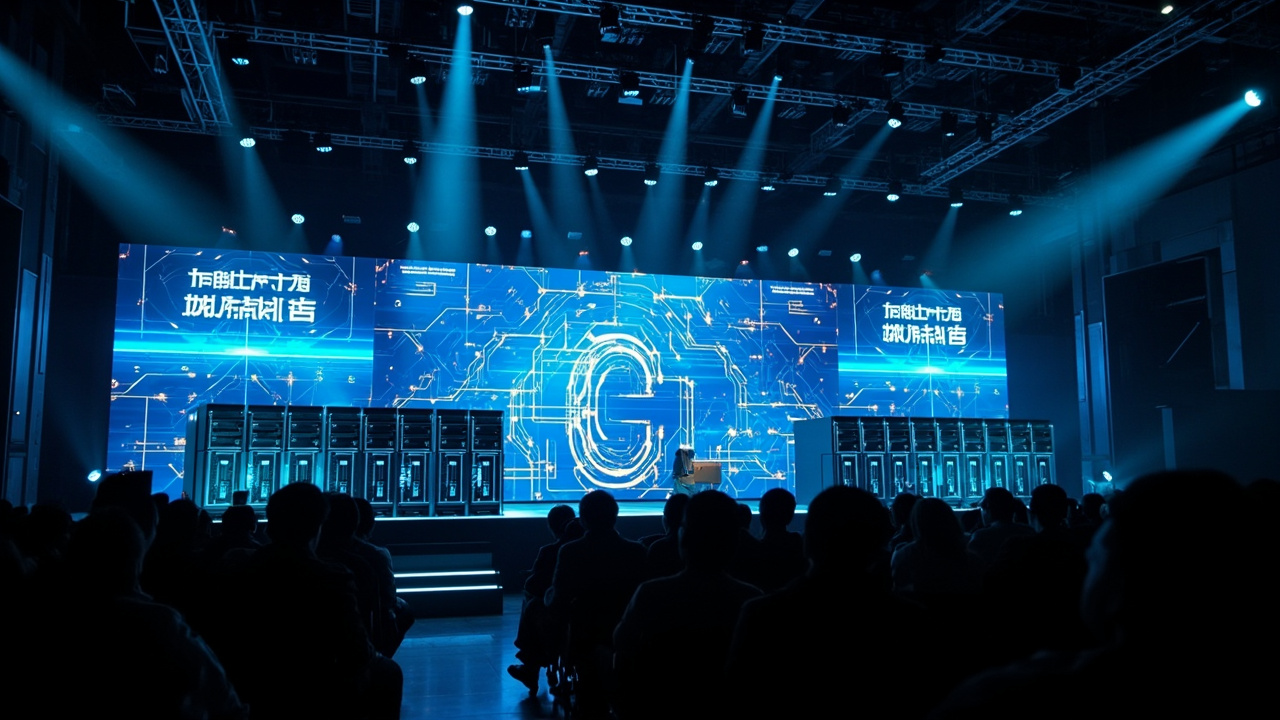
TL;DR: Huawei used HUAWEI CONNECT 2026 in Shanghai on September 17, 2026 to launch new AI computing hardware and detail future Ascend chips aimed at rivaling Nvidia systems.
Huawei Technologies put AI infrastructure at the center of its annual flagship event on September 17, 2026, using opening keynotes at HUAWEI CONNECT 2026 in Shanghai to introduce SuperPoD computing systems and to outline a yearly Ascend chip roadmap, according to Huawei and reporting from Reuters and AP News.
The Shanghai gathering, held at the Shanghai World Expo Exhibition & Convention Center and Shanghai Expo Center and scheduled to run from September 17 to 19, served as the venue for two complementary announcements: new large-scale systems designed to link thousands of processors, and next-generation chips planned for 2027 through 2029, according to Huawei.
What Huawei launched in Shanghai
David Wang, Deputy Chairman of the Board and Rotating Chairman at Huawei, delivered a keynote titled Advancing the Agentic World, Building a Solid Silicon Foundation on the opening day, according to Huawei.
In that speech, Wang launched the Atlas 960E SuperPoD, described by Huawei as the industry's first SuperPoD equipped with near-packaged optics, or NPO, to accelerate training and inference for 10-trillion-parameter models.
According to AP News, Huawei introduced the Atlas 960 SuperPoD computing cluster at the event as a faster successor to the model it launched only months ago, with improvements in AI training and "inference," the process when a trained AI model makes predictions or decisions.
Huawei said its SuperPoD design connects cluster components under a single protocol with peer-to-peer interconnect, supports cross-physical-server memory access, and combines short-reach copper with long-reach optics, according to the company announcement.
The company also said it had fully upgraded the TaiShan 950 SuperPoD, applying SuperPoD architecture to a general-purpose computing system powered by all-optical UnifiedBus networking and supporting up to 4,096 NPUs, according to Huawei.
In addition, Huawei launched the OceanStor M900, described as a UnifiedBus-powered context memory storage cluster that supports direct one-hop access and provides a petabyte-scale KV cache for the L3.5 layer, according to Huawei.
Inside the Atlas 960E: optics, scale and power claims
Huawei tied the Atlas 960E to its Hi-ONE product, described as a mass-produced NPO optical engine built with Huawei's near-packaged optics and other proprietary technologies.
Hi-ONE delivers transmission capacity of 7.2 Tbit/s per engine and is described by Huawei as the industry's only NPO with a built-in light source.
The Atlas 960E SuperPoD features an orthogonal architecture and a fully liquid-cooled design, according to Huawei. With unified memory addressing enabled by UnifiedBus, a single SuperPoD can scale to 4,096 NPUs, delivering 8 EFLOPS at FP8 precision and 16 EFLOPS at FP4 precision, according to the company.
By integrating 5,500 Hi-ONE units, Huawei said the SuperPoD does not need the 48,000 800G optical modules that would traditionally be required to connect all the NPUs. The company said that approach cuts power consumption by over 550 kilowatts, doubles fault-free operating time, and achieves 99.8% system availability, according to Huawei.
With UnifiedBus networking or RoCE, multiple Atlas 960E SuperPoDs can be connected into a larger SuperCluster, according to Huawei. With a two-tier, four-plane Clos architecture, the SuperCluster can interconnect up to 512,000 NPUs, and with a multi-rail topology it can support up to one million NPUs, according to the company.
Reuters separately reported Huawei's description of a new computing architecture called Peerium, designed eventually to allow as many as 1 million processors to operate together as a single system.
Ascend chips planned for 2027, 2028 and 2029
Huawei used the event to detail timing for future Ascend processors, framing them explicitly as planned releases rather than products already shipping.
Rotating chairman David Wang said the Ascend 960DT chip would be ready in the first quarter of 2027, three quarters earlier than previously planned, and the 960PR would be ready in the third quarter of 2027, one quarter ahead of schedule, according to Reuters.
Huawei said development on Ascend 960 had exceeded expectations, with performance doubling as planned, according to the company's keynote summary.
The company also said it was evolving the Ascend series on a one-generation-a-year cycle, stating: "We're evolving our Ascend chip series on a one-generation-a-year cycle," according to Huawei.
Under that plan, Huawei intends to release a new generation of Ascend chips every year, with the Ascend 970 and Ascend 980 to follow in 2028 and 2029, respectively, according to Reuters. AP News likewise reported that Huawei plans to launch the Ascend 970 and 980 chip series in 2028 and 2029, with expectations of significant improvements in computing power.
Rotating chairman Eric Xu separately said testing of the Ascend 950DT AI chip had produced good results and that Huawei was in extensive discussions with Chinese AI model developers, according to Reuters. He expected many developers to begin training models on systems using that chip next year, according to Reuters.
Huawei has a rotating-chair system in which senior executives take turns leading the company for six-month periods, according to Reuters.
Demand exceeds supply, Huawei says
A central message from Huawei leadership was that domestic demand for AI computing equipment currently exceeds the company's production capacity.
Huawei Technologies cannot produce enough AI computing equipment to meet demand in China and is limiting overseas sales, rotating chairman Eric Xu said at the Huawei Connect conference in Shanghai, according to Reuters.
"Since we don't have enough capacity to even satisfy the demand in China, we don't have a plan to expand into the international market in a fully-fledged way," Xu told reporters, according to Reuters.
Xu said Huawei supplies some countries where demand is particularly strong, but volumes remain limited, according to Reuters.
He also said reliable data on Nvidia's share of China's AI chip market was difficult to obtain, but added: "I think Ascend market share should be bigger than Nvidia's," according to Reuters. Huawei did not provide data to support that estimate, according to Reuters.
Xu explicitly linked the chip effort to China's push to reduce reliance on foreign technology, according to Reuters.
"We cannot accept a destiny where we cannot control our fate being determined by others in terms of willingness to sell chips to China or not," he said, according to Reuters. He added: "No matter if it's for the Chinese government, industry in China, or for Huawei, it is certainly the way forward to try to push for full self-sufficiency for chips," according to Reuters.
Guo Ping, chairman of Huawei's supervisory board, told employees in remarks released during the same week that the company viewed AI as its "biggest opportunity" and wanted its computing and connectivity infrastructure to play a role comparable to Nvidia's, according to Reuters.
Why Huawei is betting on linking many processors
Huawei framed its strategy as compensating for limits on individual chips by connecting large numbers of processors so they can work together as a larger computing system, according to Reuters.
The company said clusters of about 100,000 chips have become standard for training some of the largest AI models, while communication between machines can consume more than 40% of training time in conventional server systems, according to Reuters.
Huawei's UnifiedBus technology connects processors, memory, storage and networking equipment inside those systems, according to Reuters.
The company provided additional context in its keynote materials, saying 100k-NPU computing clusters have become the baseline for training state-of-the-art models, while traditional server architectures result in intra-cluster communications accounting for over 40% of total training time, according to Huawei.
Simulation results from Huawei's Markov Lab show that a 100k-NPU cluster built with 4k-NPU SuperPoDs can deliver a 2.75x increase in Model FLOPs Utilization compared with a 100k-NPU cluster composed of 8-NPU servers, according to Huawei.
Huawei said its new Ascend 960 supernode would connect as many as 4,096 AI processors, according to Reuters. Multiple supernodes could then be linked into clusters containing hundreds of thousands of processors, with the largest planned systems supporting as many as 1 million, according to Reuters.
Adoption figures cited by Huawei
Huawei also cited deployment and ecosystem figures for its existing systems, without independent verification in the materials reviewed.
The company said it had already deployed more than 1,000 systems using its earlier Ascend 910C processors, while its Ascend 950 systems have entered commercial use, according to Reuters. Huawei separately said more than 1,000 Atlas 900 A3 SuperPoDs have been deployed and that the Atlas 950 SuperPoD is seeing large-scale commercial use, according to Huawei.
Huawei said more than 5,200 developers were active each month on software for its Ascend chips and that more than 40 AI models had been trained directly on its computing platform, according to Reuters.
On open ecosystems, Huawei said its Kunpeng ecosystem has attracted 4.16 million developers worldwide, according to the company. It said its CANN platform has moved to sustained, community-driven open-source development, Ascend now spans over 90 third-party open-source projects, and Ascend is officially supported as a PyTorch accelerator backend, according to Huawei.
The company said CANN's shift from usable to user-friendly marked a new inflection point for the Ascend ecosystem, according to Huawei.
U.S.-China technology backdrop
According to AP News, Huawei's announcement came just days before an expected meeting between U.S. President Donald Trump and Chinese President Xi Jinping in Washington on Sept. 24.
China has pursued technological self-reliance, including in chips, as U.S.-led restrictions limited access to some advanced AI chips and chipmaking machines, according to AP News. Huawei has faced separate U.S. trade restrictions since May 2019, according to Reuters.
Advanced AI model training in China still often relies on U.S. chips, including those from Nvidia, analysts say, according to AP News. At the same time, Huawei has made its own advanced chips and maintains a lead over Chinese chip developers as Chinese AI companies increasingly use domestic chips, according to AP News.
George Chen, a partner and chair of digital practice at The Asia Group consultancy, said the timing underscored Beijing's confidence and ambition in technology and innovation, according to AP News.
"The timing — less than two weeks before President Xi Jinping's visit to Washington — underscores Beijing's confidence and ambition in technology and innovation," Chen said, according to AP News.
Chen also said: "AI developments move so quickly that no one can be certain of holding the lead forever," according to AP News. He added that Huawei achieving the upgrade in about a year would heighten U.S. concern about accelerating AI competition, according to AP News.
Huawei's announcement also came as Trump downplayed calls by AI leaders to slow development for safety purposes and insisted the U.S. must maintain its lead over China, according to AP News. "Whoever wins in AI, wins," Trump said, according to AP News.
Sources referenced
- Huawei unveils new chip technologies as Chinese firm steps up the AI race with Nvidia | AP News (https://apnews.com/article/huawei-ai-chips-nvidia-superpod-technology-26ab418df1339c518483918218ffbe57)
- China's Huawei says AI chip demand outstrips supply as it steps up Nvidia challenge | Reuters (https://www.reuters.com/world/asia-pacific/chinas-huawei-launch-two-new-ai-chips-2027-2026-09-17/)