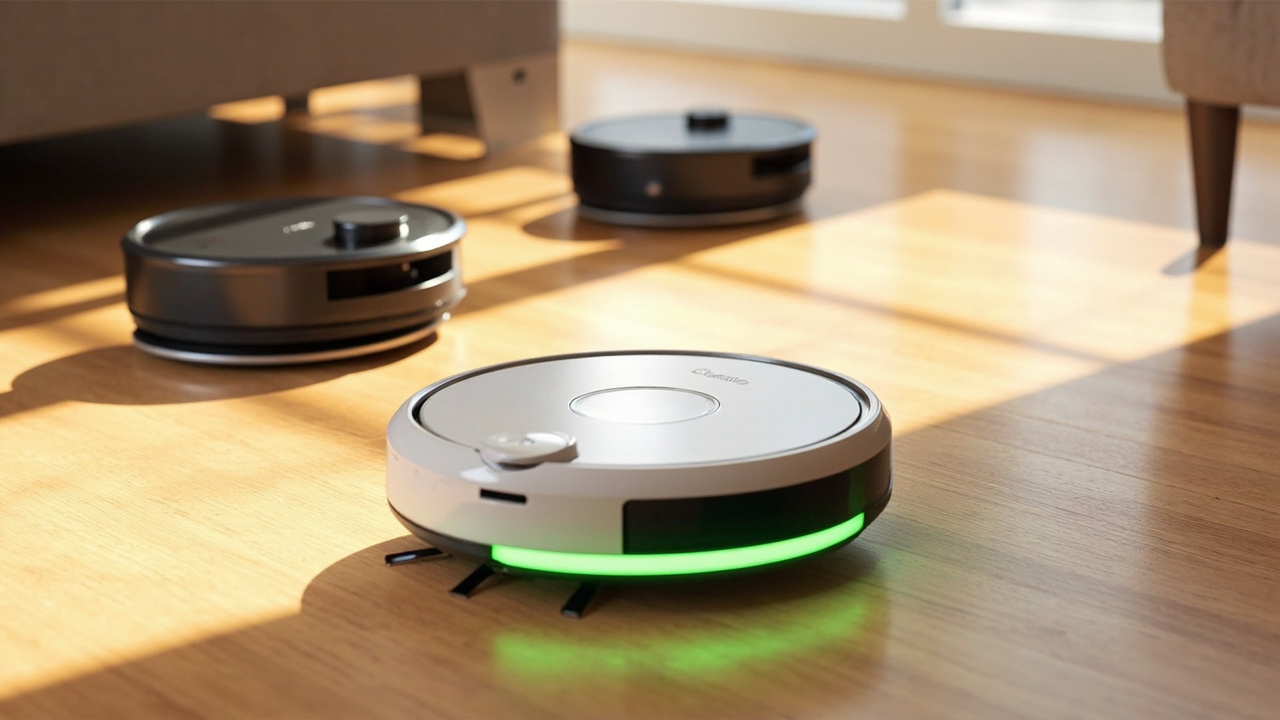
TL;DR: Dyson unveiled three Nurovi robot vacuums on September 3, 2026, led by the R3 Spot+Scrub UV that uses UV light and AI vision to identify nearly 200 substances and re-clean stains.
Launch answers Dyson's push into intelligent cleaning
Dyson introduced its Nurovi robot range on September 3, 2026, in Berlin. Chief Engineer Jake Dyson presented the machines at an event called Dyson Unveiled, according to PR Newswire.
The company said the name Nurovi combines Neural Intelligence technology with a Vision system. Dyson described the line as intelligent machines that can see, think and respond, according to PR Newswire.
The range contains three robots. They are the R1 Nurovi Dry, the R2 Nurovi Wash+Dry and the R3 Nurovi Spot+Scrub UV, according to T3.
Jake Dyson said robotic cleaning depends on how an entire system works together, not suction alone. He said the Nurovi robots were rethought from debris capture to edge cleaning to sensing, according to Dyson's September 3 announcement.
Reporting from IFA in Berlin noted limited demonstrations of navigation improvements tied to neural processing and camera vision, according to The Verge. The Verge described Nurovi as pairing neural intelligence with camera-based vision for improved navigation over prior models.
The announcement formed part of a wider reveal of 10 products built around machine intelligence, according to PR Newswire. Other products in that reveal included the CameraJet toothbrush, HushJet purification range, W1 PencilWash, Corrale Coolshine straightener and Airsmooth dryer brush, according to PR Newswire.
Meet the three models
R3 Nurovi Spot+Scrub UV targets stains
The R3 Nurovi Spot+Scrub UV is positioned as the most advanced wet-and-dry robot in the trio, according to PR Newswire. Dyson said it reveals, identifies and eliminates invisible stains with UV-enhanced artificial intelligence.
Its stain-detection system combines UV light, AI vision and green illumination, according to PR Newswire. T3 described the illumination as green laser-like light working alongside UV and AI vision.
Dyson said the system can identify nearly 200 types of household substances and objects, according to PR Newswire and T3. Once a stain is found, the robot cleans the area repeatedly until the stain is removed, according to T3 and PR Newswire.
The machine uses a self-cleaning wet roller fed by a 12-point hydration system, according to PR Newswire. That system continuously applies fresh water heated to 70°C, described as 158°F, while the roller cleans itself on every rotation, according to T3 and PR Newswire.
The full-width microfiber roller extends 40 millimeters, described as 1.6 inches, to reach room edges, according to PR Newswire and T3. For dry cleaning, the motor produces 30,000 Pa of suction for hard floors and carpets, according to PR Newswire and T3.
Dyson said that output represents 65% more suction pressure, according to PR Newswire. Its hygienic cyclonic bagless dock automatically empties, cleans and recharges after every clean, according to PR Newswire.
The Verge listed the R3 at $1,199 and described it as a white vacuum-and-mop with an extending roller mop for edges. The Verge also described the R3 as an upgraded version of Spot+Scrub AI with UV detection and green illumination to spot stains.
R2 Nurovi Wash+Dry focuses on corners
The R2 Nurovi Wash+Dry is a vacuum-and-mop robot built around corner coverage, according to T3. It replaces conventional circular pads with pads shaped as Reuleaux triangles, according to T3.
Dyson said the Reuleaux triangle pads use constant-width geometry, according to its September 3 announcement. The company explained that the shape is formed from three circular arcs, according to PR Newswire.
The design lets the pads move smoothly like circles while corner points reach into edges, according to Dyson's announcement. Dyson added that a precise eccentric movement pattern maximizes contact along walls and into corners, according to that announcement.
Deep cleaning is supported by water heated at the dock to 167°F, according to PR Newswire. Dyson's announcement described heated-water pad washing at 75°C followed by drying with 45°C hot air to prevent mould and odour build-up.
For vacuuming, the R2 uses Dyson's Twin-capture system, according to T3. Bristles on the brush bar mechanically sweep larger debris into the machine, while the vacuum motor concentrates on fine dust and smaller particles, according to PR Newswire.
Dyson said that split approach reduces reliance on suction for heavy particles and delivers more consistent performance across debris types, according to PR Newswire. The R2 also includes an acoustic piezo sensor that detects dust levels and floor types in real time, according to PR Newswire.
That sensing automatically adapts suction power and cleaning behavior across surfaces, according to Dyson's announcement. T3 reported that the system adjusts suction and cleaning behavior as the robot moves through the home.
R1 Nurovi Dry handles vacuum-only work
The R1 Nurovi Dry is the dedicated dry-cleaning model for carpets and hard floors, according to T3. It uses the same Twin-capture technology as the R2, according to T3.
The system separates fine and coarse debris, with mechanical sweeping for larger items and focused suction for finer dust, according to T3 and Dyson's announcement. Dyson's listed suction for the R1 is 21,000 Pa in detailed specifications reported for Japan.
Dyson redesigned the side sweepers to better control dust direction, according to T3. The company said the sweepers use a precise angle and webbed connector to guide debris into the airflow path rather than scattering it, according to its September 3 announcement.
The sweepers extend outward toward walls and into corners, according to Dyson's announcement. Dyson said the anti-tangle design reduces hair wrapping and supports consistent pick-up of long and pet hair in hard-to-reach areas, according to that announcement.
Docks, sensors and app control
Dyson equipped the range with a bagless docking station containing eight cyclones, according to Dyson's announcement. The dock hygienically empties dry debris after every clean, according to that announcement.
The sealed system can store up to 90 days of dry waste, according to Dyson's announcement. Dyson said the approach helps the robot maintain suction and optimal performance on every clean.
For the R2, the larger dock also washes, refills and recharges, according to Dyson's announcement. It washes the triangle pads with heated water after every clean before drying them with hot air, according to that announcement.
The robots bring acoustic dust sensing from Dyson cordless vacuums into autonomous form, according to Dyson's announcement. A piezo sensor detects dust levels in real time and directs power where needed, according to that announcement.
Floor-detect technology also identifies floor types and adapts behavior in automatic mode, according to Dyson's announcement. The MyDyson app provides schedules, zones, real-time monitoring, cleaning modes and data-driven coverage insights, according to that announcement.
Through the app, users can define specific zones and customize modes for their home environment, according to Dyson's announcement. The app also displays cleaning performance while the robot works, according to that announcement.
Prices and availability differ by market description
T3 reported that the R1 and R2 were available from September 3 at £499.99 and £749.99 respectively. T3 reported that the more advanced R3 would follow in early 2027, with pricing still to be confirmed.
The Verge, reporting on September 4, listed the R3 at $1,199. The Verge reported that all three robots go on sale this month.
Dyson's own September 3 announcement said it was launching the R1 and R2 without stating consumer prices in the release text. Detailed Japan specifications listed the R1 and R2 at open pricing and gave robot dimensions of 352 mm wide by 352 mm deep by 96 mm high.
Those Japan specifications listed the R1 at 3.4 kg and the R2 at 3.5 kg. They listed maximum operating times of about 120 minutes for the R1 and about 90 minutes for the R2, with charging time of about 6.5 hours.
The R3 remains the planned flagship for buyers seeking combined vacuuming, mopping and stain hunting. The R2 is aimed at homes needing vacuuming plus corner-focused mopping, while the R1 covers dry vacuuming only.
Dyson has a limited history with robot vacuums despite work in the category going back 20 years, according to T3. T3 noted that the Nurovi launch refocused attention on floorcare two days after Dyson introduced its CameraJet toothbrush.
Sources referenced
- Dyson just launched 3 new robot vacuums – including one that can spot stains and repeatedly clean until gone | T3 (https://www.t3.com/home-living/vacuum-cleaners/dyson-just-launched-three-robot-vacuums-including-one-that-can-spot-stains-and-repeatedly-clean-until-gone)
- Introducing the new Dyson R1 Nurovi Dry and Dyson R2 Nurovi Wash+Dry robot vacuums (https://www.dyson.com/discover/news/latest/introducing-r1-nurovi-r2-nurovi)