TL;DR: Mass-spectrometry proteomics of 28 microsamples from 14 Egyptian objects identified cow, sheep, goat, horse, donkey and antelope glues plus sesame and moringa seed proteins.
A tiny sample answers a large question
Researchers used mass spectrometry-based proteomics to read surviving proteins in paints, binders and adhesives from ancient Egyptian artifacts, according to Ars Technica. The work appeared as a new paper in the journal Science Advances and examined objects dated between 1425 BCE and 400 CE.
The team collected tiny samples from several Egyptian artifacts held in collections in Sweden, the United Kingdom and Denmark. Those pieces included painted wooden coffins, wall-painting fragments from a tomb, painted plaster used to make a mummy bust, and painted limestone architectural elements. The sampling approach was deliberately minimal because complete analysis would otherwise damage valuable artifacts.
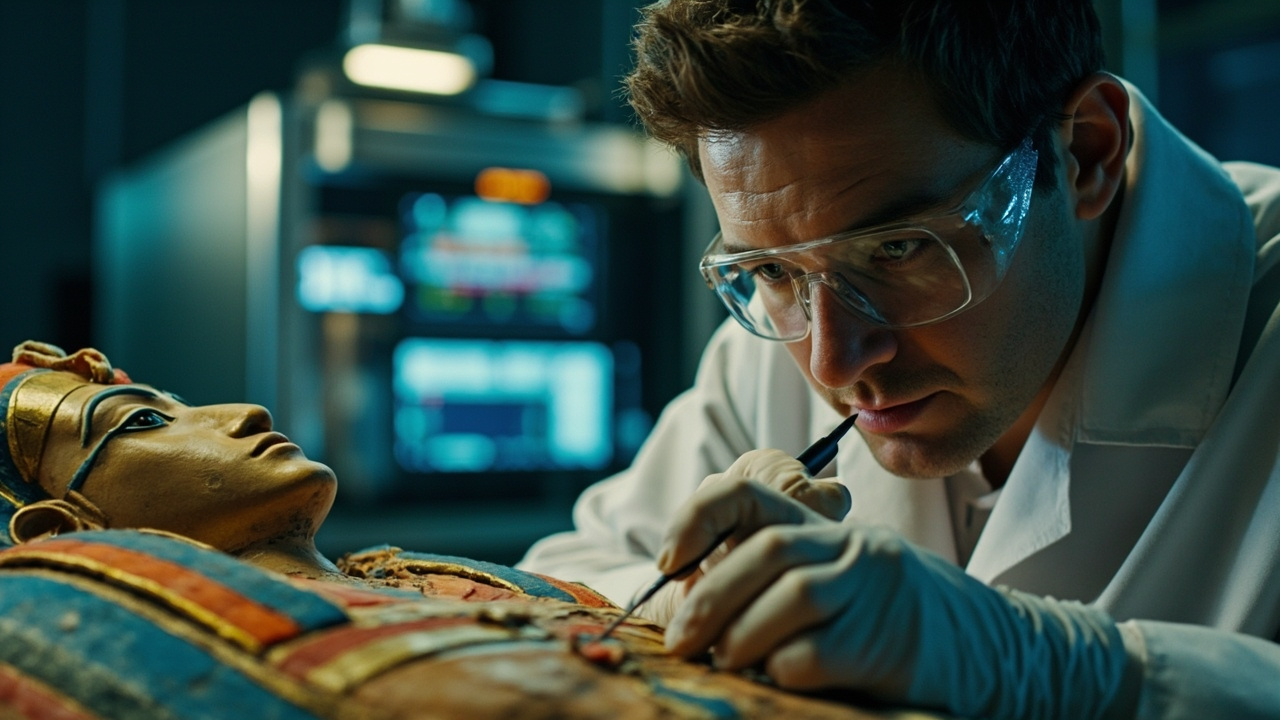
One documented sampling moment shows Clara Granzotto, assisted by conservator Inger Jonsson, taking a micro-sample for proteomics analysis from the painted surface of a mummy mask of a woman. That image is credited to Johan Jeppsson and the Museum of Mediterranean and Near Eastern Antiquities in Stockholm.
Why proteins instead of pigments
For centuries, scientific attention concentrated on the brilliant pigments of Egyptian art, according to ZME Science. Pigment nevertheless is only part of a painting. Artists also required materials that fixed powdered color to a surface, prepared the layer beneath paint, or joined parts of an object.
Animal glue was already a leading suspect because Egyptians could produce it by heating collagen-rich tissues such as hides, bones and connective tissue in water. Suspecting the process was not the same as proving which animals supplied it.
Mass spectrometry-based proteomics offered a different path. The method breaks proteins into smaller fragments called peptides, which can function like biological fingerprints, according to ZME Science. The fragments sometimes reveal not only that animal glue is present, but which animal produced it.
According to Ars Technica, the technique can provide a thorough and detailed characterization of protein residues in a sample, along with accumulated damage. It is sensitive enough to require less material than other methods. Unlike gas chromatography-mass spectrometry, it can characterize all proteins present, regardless of mixture complexity, rather than remaining narrowly targeted to predefined proteins.
28 microsamples across three museums
The researchers examined 28 microsamples from 14 painted objects dating from about 1425 BCE to 400 CE, according to ZME Science. The objects came from the British Museum in London, the Medelhavsmuseet in Stockholm and the Ny Carlsberg Glyptotek in Copenhagen.
The same broad sample set is described by Ars Technica as artifacts from Sweden, the UK and Denmark. In addition to the artifact samples, the team analyzed blank negative control samples. Researchers also examined chemical damage to detected proteins in order to exclude possible laboratory contamination from the final results.
That contamination check mattered because the target molecules were old, scarce and easily overwhelmed. Ancient proteins accumulate damage over time, and modern handling can introduce unrelated proteins. By assessing damage patterns and comparing blanks, the team separated likely ancient residues from later introduction.
Everyday glues from cattle and other animals
The results confirmed frequent use of cow glue, as well as collagens derived from sheep, goats, horses, donkeys and antelope, according to Ars Technica. Those materials were most likely prepared by boiling animal skin and connective tissue.
The animal products did not occur only where modern observers might expect glue. They also appeared in paint and ground-layer samples. That distribution suggested that Egyptians selected materials based on ready availability.
The paper reported no notable correlation between animal species or body part and object type, application, color, chronology, geographical origin, or funerary versus palatial context. In other words, the study did not find separate animal-glue recipes reserved for coffins, tomb walls, plaster busts or limestone architecture within the tested set.
According to ZME Science, cattle predominated, but researchers also detected collagen associated with horses, donkeys and sheep or goats, along with proteins that could derive from certain antelope relatives. Some samples contained mixtures from several animals. The variation points to workshops that used available resources rather than following one universal formula.
The analysis also found expected sources including animal collagens and egg proteins, according to Ars Technica. Egg therefore remained part of the documented organic repertoire, alongside the broader range of animal tissues.
Sesame and moringa enter the picture
The most unexpected result involved plants. Researchers detected distinctive seed proteins from sesame and moringa, also called drumstick tree, according to Ars Technica. ZME Science identifies the latter as Moringa oleifera.
Researchers found sesame seed-storage proteins in both a roughly 3,300-year-old fragment of the famous Tomb of Nebamun paintings and a much later Greco-Roman wooden coffin. In the coffin’s red paint, they found proteins from Moringa oleifera. The Tomb of Nebamun belonged to a middle-ranking official described as scribe and grain accountant during the New Kingdom period.
Lead author Clara Granzotto told Chemical & Engineering News that this was the first molecular evidence of the presence and use of materials from these two plants in painted artifacts from ancient Egypt, according to ZME Science. That statement frames the botanical detection as a new molecular observation rather than proof of a widespread standard.
Chemical tests indicated that protein formed the dominant organic material, accompanied by traces of oil. The team therefore did not interpret sesame or moringa oil as an ordinary paint binder. Instead, researchers proposed that artists could have used a protein-rich by-product of seed processing, perhaps material left behind after extracting valuable oil.
A workshop linked to food, medicine and ritual
Sesame and moringa were common at the time in ancient Egypt. Their oils could serve food, medicine, cosmetics, mummification and other uses, according to ZME Science. Process residues might still have retained value for a craftsperson.
That possibility connects painting to a larger ancient economy. A workshop may have received secondary materials after seeds were processed elsewhere for higher-value oil. Using the remaining protein-rich fraction would have made technical and economic sense without requiring oil itself to carry the paint.
Moringa carries an additional possible layer of meaning. The tree had a symbolic association with Ptah, the ancient Egyptian patron god of craftsmen. An ancient epithet described him as “Ptah Who is Under His Moringa Tree,” and a seal dating to roughly 1390 to 1352 BCE depicts the association.
The study’s authors suggested that finding moringa in an artwork could potentially help explain that link, or that artisans might have incorporated the material as an act of dedication or protection. More Egyptian artwork will need testing before scientists know whether moringa appears systematically in particular objects, places or religious contexts.
Pigments were already better understood
The new protein work complements extensive pigment research. Ancient Egyptian artists used hematite and realgar for red, goethite and orpiment for yellow, Egyptian blue, Egyptian green, carbon-based black, and calcite, gypsum, anhydrite and huntite for white, according to Ars Technica.
Many of those pigments contain elemental markers detectable by X-ray fluorescence imaging. Macro-XRF imaging, sometimes combined with hyperspectral imaging, had previously been used to study a Greco-Roman painted funerary portrait from the second century CE and remnants of color on marble at Delphi in Greece. In 2023, scientists used a portable MA-XRF imaging device to study Egyptian paintings in tomb chapels in the Theban Necropolis.
Proteomics adds the organic side of the recipe. Pigment analysis can identify colorants; protein analysis can identify the biological substances that helped powder adhere, coated preparation layers and bonded components.
A method already tested on later art
The Egyptian study was not the first cultural-heritage application of the approach. In 2023, scientists used proteomics to discover that beer byproducts were popular canvas primers for artists of the Danish Golden Age, according to Ars Technica. Earlier in 2026, researchers identified proteins from fingerprints left by Renaissance readers of medical manuals, revealing more about hands-on knowledge in that period.
Those precedents help explain why the method transferred well to older and more complex Egyptian mixtures. It does not require investigators to guess every ingredient in advance. It can survey complicated protein mixtures and then use peptide patterns to assign likely biological sources.
What conservators gain
For conservation, the distinction between cattle, horse, donkey, sheep, goat and antelope collagen is more than taxonomy. Different source tissues and preparation methods can affect solubility, strength, aging and response to humidity. Knowing that ground layers and paints also contain animal products helps explain past behavior and guides safer treatment choices.
Plant residues add another conservation variable. A protein-rich seed by-product may age differently from animal glue or egg. Traces of oil, even when minor, can influence cleaning, consolidation and environmental controls.
The study does not claim that every Egyptian workshop used sesame or moringa. The tested set comprised 14 objects and 28 microsamples, a detailed but limited window into production spanning more than 1,800 years. Its contribution is to establish that such plant materials could enter painted artifacts and to provide a method for recognizing them elsewhere.
Future sampling can test whether sesame clusters in particular periods, whether moringa associates with red paint or coffins, and whether Ptah-related symbolism guided selection. Until then, the molecules preserve a practical record: boiled tissues, eggs, grains and processed-seed remnants helped carry images intended to endure.
Sources referenced
- Scientists unlock secrets of ancient Egyptian materials with proteomics - Ars Technica (https://arstechnica.com/science/2026/09/scientists-unlock-secrets-of-ancient-egyptian-materials-with-proteomics/)
- Ancient Egyptians Were Putting Some Strange Things into Their Paint - ZME Science (https://www.zmescience.com/science/archaeology/ancient-egyptians-were-putting-some-strange-things-into-their-paint/)