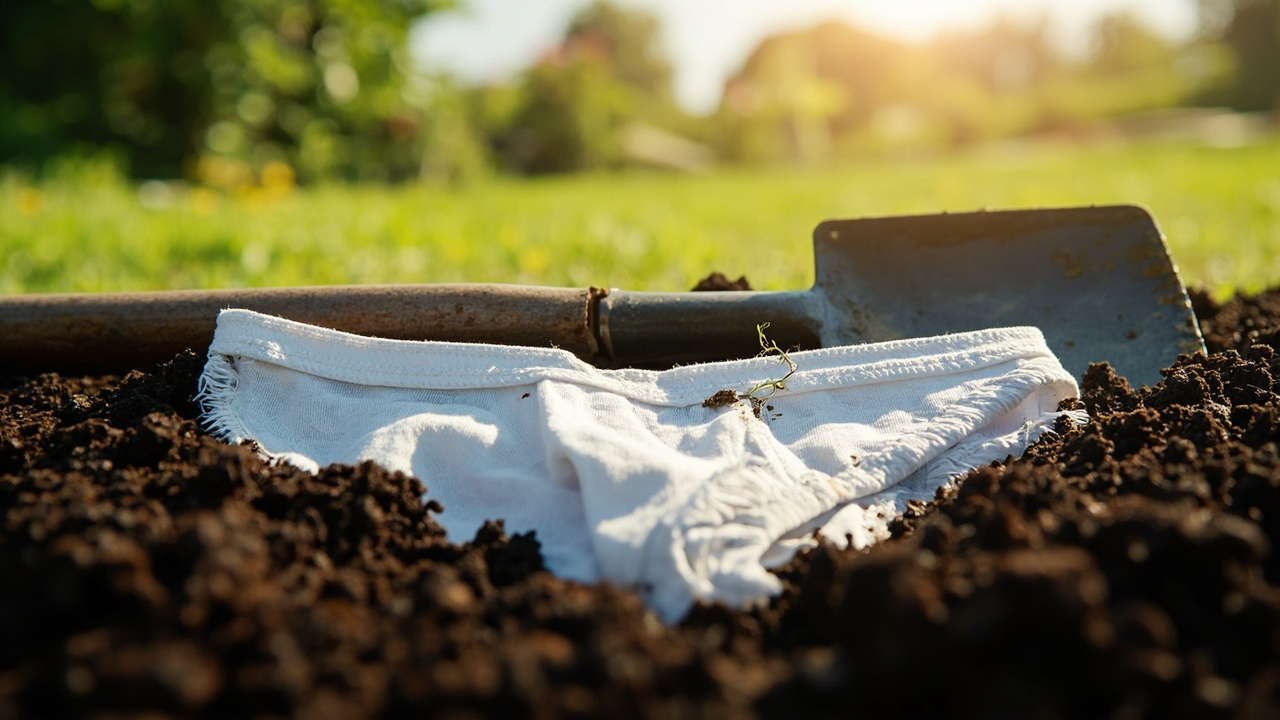
TL;DR: About 1,000 volunteers buried more than 2,000 pairs of cotton underwear and 12,000 tea bags to measure soil biological activity, and garden soils decomposed the cotton fastest while lawns decomposed it slowest.
1,000 Volunteers Buried Underwear to Map Soil Life
About 1,000 volunteers buried more than 2,000 pairs of cotton underwear and 12,000 tea bags at around 1,000 locations and dug them up after two months to photograph decomposition and send fabric plus soil samples to a laboratory, according to the University of Zurich. The work was organized as Proof by Underpants, known in German as Beweisstück Unterhose, by the University of Zurich and Agroscope, the Swiss federal center of excellence for agricultural research, according to the University of Zurich. The project started in 2021 to draw attention to soil as an overlooked ecosystem and to collect scientific data on activity of soil organisms, according to the University of Zurich. The analysis was published in the journal Plants, People, Planet as a map of soil activity, with a DOI of 10.1002/ppp3.70259, according to the University of Zurich and Ars Technica.
Why soil decomposition was the target
Soil stores water, carbon and nutrients and hosts a large share of global biodiversity, with more than half of global biodiversity estimated to live below ground, according to the University of Zurich. Biodiversity and soil health are declining worldwide, with consequences for agriculture, food security and functioning of entire ecosystems, according to the University of Zurich. Soil health is critical for agriculture and food security and for a healthy global ecosystem, but it has declined worldwide, according to Ars Technica. One key indicator of soil health is decomposition rates of complex organic matter, which breaks down leaves, wood and even cadavers into simpler organic and inorganic compounds while releasing carbon dioxide and nutrients, according to Ars Technica. There have been relatively few large-scale national decomposition studies involving different land-use types, although smaller studies have shown that human use of a site can significantly affect biological diversity in soil, according to Ars Technica.
How the burial experiment was organized
Each volunteer selected a site, dug a hole and collected a soil sample before placing underwear and tea bags in the ground, according to Ars Technica. Volunteers received an activity pack containing two pairs of organic cotton men's underpants, 12 tea bags and a sampling bag for soil collection, along with detailed instructions, according to Ars Technica. They inserted the two pairs of underpants vertically, side by side, with the synthetic waistband visible on the surface, according to Ars Technica. They placed six tea bags in front of each garment to compare underpants with the teabag index as a decomposition assessment, then refilled the hole, according to Ars Technica. Participants dug up the first pair of underpants and associated tea bags after 30 days and the second pair after 60 days, documenting the condition of the items and mailing all materials to scientists for analysis, according to Ars Technica. In the Swiss field design described by Popular Science, volunteers buried a combination of cotton underwear and clean tea bags at roughly 1,000 strategically selected locations around Switzerland. Participants then retrieved the items two months later, photographed decomposition progress and mailed them to a laboratory along with a soil sample, according to Popular Science. About 240 volunteers are listed as co-authors on the paper, according to Ars Technica.
What faster cotton breakdown means
The decomposition rate provided a measure of biological activity, with more active soil organisms breaking down cotton material faster, according to the University of Zurich. After two months underground, cotton underwear showed clear signs of decomposition by soil organisms compared with a new pair, according to the University of Zurich. Slightly or heavily decomposed cotton illustrated differences in activity, with faster cotton breakdown where soil organisms were more active, according to the University of Zurich. Underwear decomposition differed greatly across land-use types, indicating significant variation in soil biological activity among sites, according to the journal abstract summarized by Exa research. Decomposition of underpants and tea bags was considered as a proxy for soil biological activity and soil health, according to the journal abstract summarized by Exa research.
Where cotton disappeared fastest and slowest
Underwear decomposed most rapidly in private gardens, where researchers found the highest levels of organic matter, according to the University of Zurich. Those garden conditions were described as ideal for earthworms, fungi, bacteria and other soil-dwelling organisms, according to the University of Zurich. Residential gardens also showed the highest levels of organic matter needed for bacteria, fungi, earthworms and other underground organisms, according to Popular Science. Soil organisms were least active in lawns, while agricultural fields and meadows fell somewhere in between, according to the University of Zurich. Farmlands and meadows ranked slightly less organically active than gardens, while manicured lawns took last place, according to Popular Science. Underpants decomposed fastest in private gardens and slowest in lawns, with agricultural fields and meadows ranging in the middle, according to Ars Technica. Private gardens, the land-use type with the highest levels of soil organic carbon and nutrients, exhibited the greatest biological activity, whereas lawns showed the lowest, with croplands and grasslands falling in between, according to the journal abstract summarized by Exa research.
Why land use outranked other soil factors
Land use proved to be the most important factor influencing how quickly underwear decomposed, according to the University of Zurich. Whether a site was used as garden, meadow, cultivated field or lawn explained differences better than most measured soil properties, according to the University of Zurich. Land use was the most important predictor of decomposition processes, followed by soil chemical parameters, according to the journal abstract summarized by Exa research. Chemical soil characteristics, such as nutrient levels, also played a significant role, according to the University of Zurich. Temperature and moisture levels also affected organism activity, particularly if conditions were too cold or too dry, according to Ars Technica. Soil life also depends strongly on temperature and soil moisture, and soil is barely active if conditions are too cold or too dry, according to the University of Zurich.
“Our results show that how soil is managed can significantly affect both soil life and soil quality,” said co-study leader Marcel van der Heijden, University of Zurich professor of agroecology, according to the University of Zurich. “Healthy, biologically active soil is crucial for fertility, nutrient cycling and many other ecosystem services,” van der Heijden said, according to the University of Zurich and Popular Science. Measures that can promote soil life include keeping soil permanently covered, adding compost, diversifying crop rotations and limiting use of mineral fertilizers and pesticides, according to the University of Zurich.
When fast decomposition signals too many nutrients
Rapid decomposition often indicates high soil fertility and a good supply of nutrients, which is particularly beneficial for agricultural production, according to the University of Zurich. However, maximum decomposition is not desirable in every ecosystem, according to Agroscope agroecological assessments team head Franz Bender as reported by the University of Zurich. In near-natural habitats such as forests, very high nutrient levels can indicate disruptions to the natural balance of nutrients, according to Bender as reported by the University of Zurich and Popular Science. In gardens, rapid decomposition may point to an oversupply of nutrients, according to Bender as reported by the University of Zurich. In those cases, it may be worth checking whether fertilizer use should be reduced, according to Bender as reported by the University of Zurich. More organically active soil is good for decomposition, but that is not always beneficial because gardens can suffer from an overabundance of nutrients, according to Popular Science. Although rapid breakdown is desirable for agricultural land, other locations do not necessarily benefit from high organic activity in soil, according to Popular Science.
Underpants index versus teabag index
Commercially available tea bags are a common material used to measure decomposition rates, known as the teabag index, according to Ars Technica. The research team felt the teabag index could be improved upon because it requires careful handling and specific tools such as a fine-scale balance, according to Ars Technica. Prior research had shown that cotton strips could also be used to assess decomposition, leading the team to test cotton underpants in citizen science, according to Ars Technica. The authors found that the underpants index provided information about soil conditions as meaningful as the teabag index, including chemical and physical properties, elevation and moisture, according to Ars Technica. Unlike the teabag index, underpants provide a direct visual and haptic measure of decomposition that is easier to interpret, the authors wrote, according to Ars Technica. That visual and tactile quality makes underpants an ideal tool for citizen-science projects and for raising awareness of soil-related issues, the authors wrote, according to Ars Technica. Burying cotton underwear can provide a simple yet meaningful way to reveal differences in biological activity and soil fertility, according to the University of Zurich. The researchers therefore propose an Underpants Index as an easy-to-understand way of illustrating soil processes and raising public awareness of protecting soils, according to the University of Zurich. The Underpants Index was proposed as an accessible, engaging method to assess soil decomposition processes and soil fertility and raise public awareness for soil as a vital yet threatened resource, according to the journal abstract summarized by Exa research. The project demonstrates that underwear decomposition varied widely across land-use types and that buried underwear is a simple and easily interpretable tool to gain a first impression of soil health, according to the journal abstract summarized by Exa research.
Sources referenced
- University of Zurich - Buried Underwear Shows Land Use Is Key to Soil Health (https://www.news.uzh.ch/en/articles/media/2026/buried-underwear.html)
- Ars Technica - Why did 1,000 world citizens bury their underpants? (https://arstechnica.com/science/2026/08/why-did-1000-swiss-citizens-bury-their-underpants/)