TL;DR: Two separate teams in Vienna and Beijing built the world's first working nuclear clocks using thorium-229 in crystals, as reported in Nature on Oct. 7, 2026.
Two laboratories separated by thousands of miles reached the same historic finish line at the same time. According to Reuters, scientific teams working separately in Vienna and Beijing developed the world's first two operating nuclear clocks, describing the result on Wednesday in papers published in the journal Nature.
The devices are not powered by fission or fusion. According to Reuters, time is calculated by monitoring how a high-powered laser interacts with the nucleus of an atom. Both instruments rely on thorium-229, an isotope of thorium, held inside solid calcium fluoride crystals, according to Reuters.
That shared choice matters because the thorium-229 nucleus has an unusual property. According to TU Wien, thorium nuclei possess two energy states spaced extremely closely together, so a laser can deliberately switch the nucleus from one state to another. Other nuclei have much larger gaps and do not respond to laser light, according to TU Wien.
Why nuclei may keep better time than electrons
Conventional atomic clocks, first created in 1949 according to Reuters, measure time with electrons. According to Reuters, those clocks use lasers or microwaves to move electrons between two energy levels in the shell around an atom, using elements such as cesium or strontium.
The new instruments move the reference inward. According to Reuters, the nuclear clocks use lasers to move protons and neutrons between energy levels inside the nucleus of thorium-229. The idea is that transitions in the nucleus could eventually allow higher accuracy because the nucleus is much smaller than the electron shell, according to Reuters.
The size difference is dramatic. According to TU Wien, atomic nuclei are more than ten thousand times smaller than atoms. Because they are so compact, they react much more weakly to external disturbances and therefore can be more reliable timekeepers, according to TU Wien.
The concept is decades old. According to Reuters, physicist Thorsten Schumm of TU Wien in Austria said the creation of a nuclear clock was something physicists dreamt of for almost 50 years, and that his team had worked toward the goal since 2008. According to EurekAlert!, physicist Ekkehard Peik proposed the principle of a thorium-based nuclear clock in 2003.
Finding the exact laser frequency took about 20 years, according to EurekAlert!. Peik compared the search to finding a needle in a haystack, saying the transition energy, known only approximately, had to be matched by a laser to within one millionth of an electron volt, according to EurekAlert!.
How Vienna made its clock self-stabilizing
The Vienna system was built by TU Wien with Germany's Physikalisch-Technische Bundesanstalt, known as PTB Braunschweig, according to TU Wien and EurekAlert!. The effort was led by Thorsten Schumm in Vienna and Ekkehard Peik at PTB, according to TU Wien.
A key advance came in April 2024, when the team led by Schumm with the team led by Peik succeeded for the first time in exciting thorium nuclei with laser beams, according to TU Wien. In the autumn of that year, the team coupled the thorium excitation apparatus to a conventional optical atomic clock and used thorium nuclei as a timekeeper, according to TU Wien.
That earlier combination was not yet a stand-alone clock. According to TU Wien, Schumm said what researchers really wanted was a self-stabilizing nuclear clock in which the laser changes the energy state of thorium nuclei and the nuclei then stabilize the laser frequency.
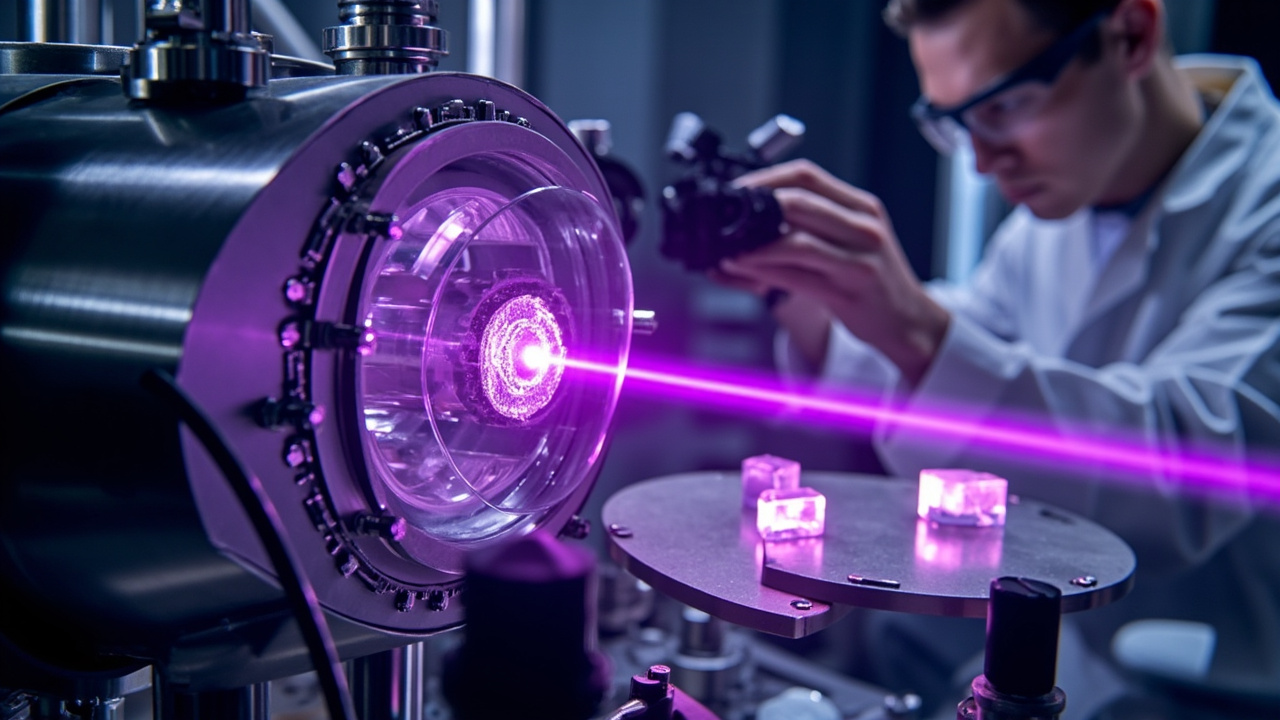
The Vienna design places a TU Wien-produced crystal containing thorium atoms in the beam of a laser, according to TU Wien. The oscillation of that laser light is used for timekeeping, but its frequency can shift slightly because of effects including temperature fluctuations, according to TU Wien. High-precision measurement therefore needs a mechanism that holds the laser rhythm exactly stable, according to TU Wien.
Thorium nuclei provide that control because they absorb laser light only when the frequency is exactly right, according to TU Wien. If the frequency moves slightly away from the optimum, absorption decreases measurably, and the laser is automatically readjusted, according to TU Wien. The result was described as the first self-regulating nuclear clock that does not necessarily rely on a conventional atomic clock, according to TU Wien.
The system was shown to remain stable for more than 24 hours without intervention, according to TU Wien. During that operation the clock was compared with an optical atomic clock at the Austrian metrology institute BEV-PTP in Vienna, according to EurekAlert!.
The laser itself represented a separate engineering step. According to EurekAlert!, the first laser system needed several square meters of optical tables and could operate only in pulsed mode. Working with the Max Born Institute in Berlin, PTB physicists developed a compact, continuously emitting solid-state laser with very high frequency resolution, presented in December 2025, according to EurekAlert!.
The older method was slow. According to EurekAlert!, researchers irradiated crystals for two minutes, blocked the beam, then measured fluorescent light from excited nuclei, a process with a time constant around 10 minutes. That delay was too slow to stabilize laser frequency to nuclear resonance as needed for clock operation, according to EurekAlert!.
With the newer, more stable laser, the team could measure laser power absorbed by nuclei instead of emitted fluorescence, according to EurekAlert!. The beam no longer needed to be blocked, there was no time delay, and the signal could tune laser frequency over short and long timescales, according to EurekAlert!.
How Beijing demonstrated reproducibility
The Beijing clock was developed independently by a collaboration of Chinese institutes led by Tsinghua University, according to the South China Morning Post. Physicist Shiqian Ding of Tsinghua University helped lead that team, according to Reuters.
Both teams used thorium-229 nuclei embedded in crystals and kept time by the rhythm of the atom's core rather than electrons, according to the South China Morning Post. Ding said the two teams worked independently and reached operating thorium-229 clocks at the same time using different experimental approaches, according to Reuters. Ding said that outcome was encouraging because it showed the concept was robust and not dependent on one technical implementation, according to Reuters.
According to the South China Morning Post, initial results indicated China's timepiece was about six times as stable as the Vienna instrument. The Beijing scientists also showed that two crystals grown separately kept the same time, a sign such clocks could be reliably reproduced, according to the South China Morning Post.
Reproducibility is important for a future time standard. According to Nature, the reports represent the first implementations of a nuclear clock and a milestone in metrology. According to Nature, Toscani De Col and colleagues also demonstrated that their clock showed promise for detecting a possible form of dark matter.
How accurate are they today?
The new clocks are highly precise but have not yet passed the best existing clocks. According to The New York Times, the nuclear clocks are so precise they would lose one second once every few million years or so.
More specific estimates point to about one second in 30 million years. According to ABC News, both clocks are so accurate that if they ran for 30 million years, they would be off by only a second. According to TU Wien, the precision investigated over a day was approximately 10 to the power of minus 15, corresponding to roughly one second in 30 million years.
That level does not yet set a record. According to Reuters, the research teams said nuclear clocks have the potential to outperform conventional atomic clocks but do not do so yet. According to Reuters, the best conventional atomic clocks can go billions of years losing or gaining only one second.
Schumm said the nuclear clock remains far from its target performance and researchers are looking to perfect the technology, according to Reuters. He added that the Vienna clock had slightly better thorium crystals with higher concentration and better optical properties, while the Beijing team had a stronger laser, so combining those components could already build a significantly better clock, according to Reuters.
The pace of improvement has been rapid for such a young field, according to EurekAlert!. Considering development times for other optical clocks, progress was described as exceptionally high, according to EurekAlert!. The nuclear clock is also the first clock based on nuclear resonance and uses solid-state material as its timekeeping element, unlike optical atomic clocks that rely on atoms or ions stored in vacuum, according to EurekAlert!.
What nuclear clocks could be used for
Even at this experimental stage, researchers see practical paths. According to Reuters, Schumm envisioned uses in satellite-based navigation, synchronization of data transfer, surveying and metrology, the study of measurement and its applications. Ultra-accurate time has already been vital for global navigation satellite systems and internet, cellular and fiber-optic communications, according to Reuters.
Researchers think perfected nuclear clocks may perform those jobs better and can be built less bulky and delicate, according to Reuters. According to ABC News, the clocks could be used in navigation, mining, earthquake prediction and potentially discovering new areas of physics. According to ABC News, both clocks remain experimental, but researchers say they will be rapidly improved.
Fundamental physics is another driver. According to Reuters, the Vienna team used its clock to seek dark matter, a crucial component of the cosmos that has eluded observation. The experiment did not detect dark matter, but the nuclear clock performed at the level of the best atomic clocks, according to Reuters. According to the South China Morning Post, the Vienna team used its clock to hunt for dark matter without success.
Another investigation examined how the thorium nucleus occupies different positions in the calcium fluoride lattice, producing a nuclear resonance spectrum with information about microscopic structure that can help optimize the clock, according to EurekAlert!. Schumm said the work gives access to a whole new physics universe, according to Reuters.
Schumm also described the broader rivalry as productive. According to the South China Morning Post, when Nature reported in June that the teams had separately developed the devices, Schumm said there was now a fierce but friendly global competition.
Sources referenced
- Scientists in Vienna and Beijing create world's first nuclear clocks - Reuters via Yahoo (https://www.yahoo.com/news/science/articles/scientists-vienna-beijing-create-worlds-150157542.html)
- New nuclear clocks could become world's most accurate timekeepers - ABC News (https://www.abc.net.au/news/science/2026-10-08/world-first-nuclear-clocks-built-most-accurate-time/107238860)