TL;DR: Georgia Tech's SWANS system uses faint voltage pulses through salty tissue to link implants without radios.
Georgia Tech engineers have demonstrated a way for medical implants to exchange commands without Bluetooth or antennas, using the body's own tissue as the conductor. The system, called the Smart Wireless Autonomous Networking System or SWANS, was described in the journal Science last week and tested in food tissues and live rats, where movement of a front paw triggered stimulation of a hind-leg nerve.
According to Ars Technica, most implants such as pacemakers and insulin pumps work in isolation today. SWANS aims to let them coordinate by sending coded electrical pulses through muscle, fat and skin, mimicking in a simplified way how the nervous system gathers inputs from many sites and issues a decision.
According to Scientific American, the approach frames the body not only as the place where devices sit but as part of the communication network itself. Co-author Yoon Jae Lee, an assistant professor of computer science at Georgia State University, described that shift in role for tissue from passive host to active channel.
Why radios struggle inside the body
Power, attenuation and size
Current communicating implants largely rely on Bluetooth Low Energy or near-field communication, known as NFC. Both were designed for air, not flesh.
The first limitation is energy. Staying alert enough to answer within milliseconds is costly for a radio. According to Ars Technica, the study reports that activated Bluetooth components can cut an implant's battery life by up to 90 percent. For a device sealed inside tissue, where a battery change means another procedure, that penalty is severe.
The second limitation is propagation. Radio waves fade quickly in watery, salty tissue. Study co-author Alex Abramson, a Georgia Tech engineer, said Bluetooth and near-field communication are attenuated quite a lot in tissue. Implant-to-implant radio links run into trouble when the path exceeds about one centimeter through tissue, according to Ars Technica's account of the paper.
The third limitation is dimensions. Radios need antennas. Commercial Bluetooth parts require a device at least five millimeters wide. By contrast, implants thinner than three millimeters can be injected with a syringe in an outpatient clinic, while larger units usually require surgery. That size gap matters for devices meant to sit deep in gut or muscle, where space is tight and surgical placement adds risk and cost.
Independent observer Hyowon "Hugh" Lee, a professor of biomedical engineering at Purdue University and a program manager at the U.S. Advanced Research Projects Agency for Health who was not involved in the work, made a related point about scale. According to Scientific American, he said smaller implants are less likely to disturb the body and surrounding tissue, summarizing the surgical reality bluntly as the body not liking to be jabbed.
What SWANS is and how it copies neurons
Ionic conduction through ordinary tissue
SWANS does not use nerves. It uses ordinary tissue as an ionic conductor. Neurons communicate by moving sodium and potassium ions across membranes to create voltage differences. SWANS creates its own brief voltage differences that spread through the salty fluid around cells.
Abramson said the design was inspired by the body's internal networks. According to Ars Technica, he explained that the nervous system takes many inputs, harvests that data and makes a specific decision, and that the engineered system mimics that pattern. Another of his quoted explanations put it more simply: instead of nerves, the team uses normal body tissue to send those signals.
The idea of sending current through tissue is not entirely new. A Food and Drug Administration-cleared pill called Abilify MyCite uses ionic conduction to tell a skin patch that it was swallowed. Those earlier links typically connect only two devices. The Georgia Tech goal was a network that could address many implants from one controller.
The three hardware pieces
Hub, microneedles and injectable nodes
SWANS has three physical parts that divide labor between a capable wearable and very simple implants.
The first part is a wearable hub built as a flexible circuit board. It reads sensor data, runs decision-making algorithms and emits voltage pulses of up to 12 volts. Because it sits outside or on the skin, it can carry a larger battery and more processing than anything implanted.
The second part is a patch of stainless-steel microneedles. It delivers those pulses into the body while bypassing the skin's outermost layer, which conducts poorly. That interface helps launch the field into deeper, saltier and more conductive tissue.
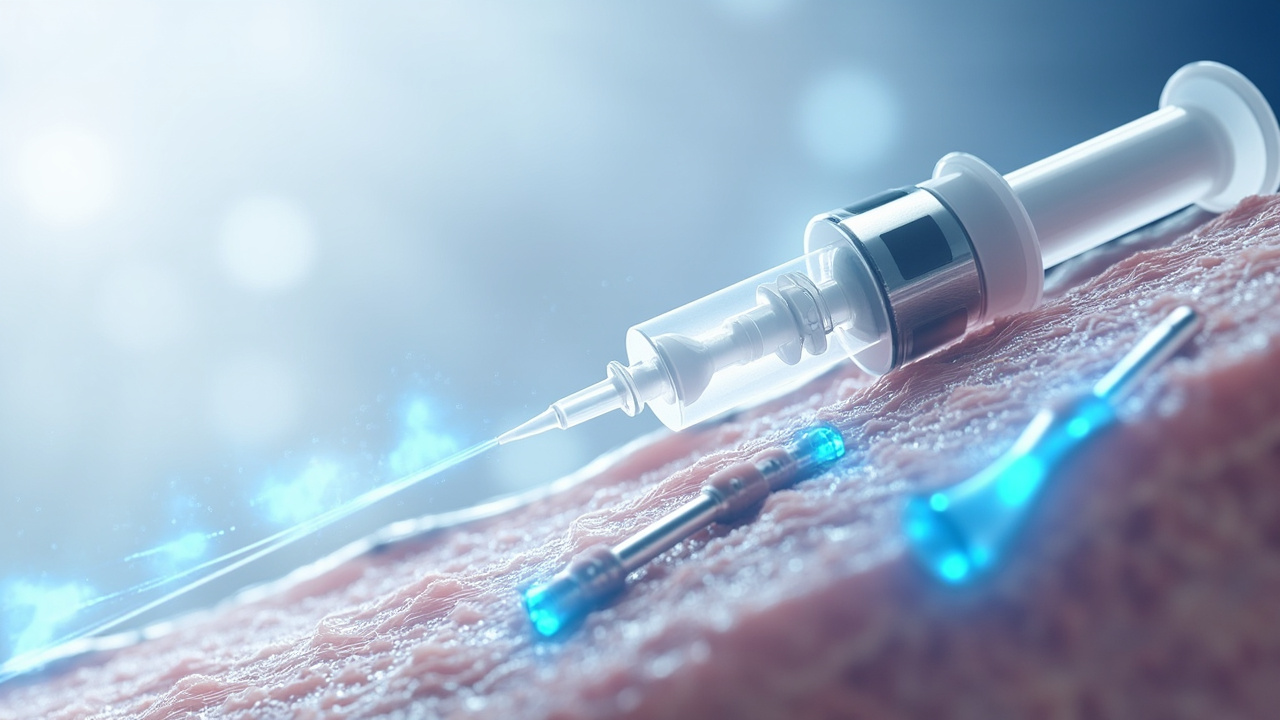
The third part is a set of syringe-injectable implants. Each contains two receiving pads, a transistor switch, a battery and either a sensor or an actuator such as a nerve stimulator. According to Ars Technica, the team put, in Abramson's words, all of the smarts in the wearable hub so the implanted nodes could remain small and simple.
When the hub fires, it creates a brief electric field that spreads in all directions. Every implant in range senses it, but only the intended device or devices act. Abramson compared the selectivity to people in a crowded room who turn only when they hear their own name.
How implants hear only their own name
Resistors, capacitors and tuned thresholds
Selectivity comes from simple electronics rather than digital addresses. Each implant's transistor turns on only when an incoming pulse crosses a particular threshold.
Adding a resistor in front of the transistor raises the voltage required to flip the switch. Adding a capacitor means the pulse must persist long enough to charge that component before switching occurs. By mixing and matching those values, the team created implants that react only to particular combinations of pulse strength and duration.
That scheme keeps listening costs extremely low because the implants are built from passive components. According to Ars Technica, they draw almost no power while waiting and extend battery life more than 15 times compared with Bluetooth and NFC. Scientific American adds that the messages stay closer to a yes-or-no trigger than to a continuous data stream.
The trade-off is calibration. The authors acknowledge that voltage thresholds need to be tuned for each body and implant placement, since tissue composition, depth and posture change how a pulse spreads. A complete implant with battery measures 3 by 1.1 by 17 millimeters and fits through a 6-gauge needle, showing how much function was squeezed into an injectable form.
What the team proved in meat and rats
Pork belly range and cross-body control
To map propagation, Abramson and colleagues installed the system in chicken breasts and in skin-on, bone-in pork bellies, plus live rats.
Pork belly was chosen because it is thick and heterogeneous, forcing signals to cross fat, muscle, bone and skin. A single 10-volt pulse produced a detectable voltage gradient more than 30 centimeters across the tissue and up to 14 centimeters deep. That coverage was more than 10 times what Bluetooth or NFC achieves in tissue, according to Ars Technica.
In live rats, placement proved forgiving. Signals reached implants under the skin, in the abdominal cavity and even in the stomach. In one configuration, the team placed the wearable on the stomach and still achieved actuation in the back.
The most advanced test linked sensing in one region to action in another. Strain sensors on the rats' front legs detected left or right forelimb movement. The hub then sent a limb-specific pulse through the body to an implant on the corresponding hind leg, which stimulated the sciatic nerve and made that leg twitch. According to Scientific American, sensors worn on the front paws reported to the wearable hub, while the actuator was a stimulator connected to the sciatic nerve in the hind limb.
The researchers also built an implant-to-implant relay. In that test, a device with a temperature sensor passed a signal to a second implant only when it registered a fever above 40 degrees Celsius, or 104 degrees Fahrenheit. The result pointed toward closed-loop behavior in which one site monitors and another site intervenes without continuous outside control.
Power, safety and limits on the road to people
A year on a daily trigger, but human distance is unproven
By keeping traffic minimal, the team projects long service from tiny cells. According to Scientific American, an actuator triggered once a day could last for about a year, which would imply an annual clinic visit to remove spent units and inject replacements. The pulses themselves are described as basically imperceptible, comparable to what a pacemaker sends to the heart.
Safety expectations rest in part on precedent. Abramson noted that pacemakers and neurostimulators already use similar voltages and pulse lengths, so the team did not anticipate major safety problems. In a two-month study in rats, scar tissue up to a millimeter thick grew around the implants. The available reporting does not present human safety data.
Distance is the clearest limit. In the study, signals traveled about 40 centimeters, enough to cross a rat but short of what many human therapies would require. Hugh Lee noted that humans are fattier and bulkier than rats, which could further restrict range. Amplifying the signals could help, provided the electronics remain small enough for injection.
Security is a second open issue. If a wearable issues commands that cause stimulation, drug release or other therapy, that link must resist accidental or malicious triggering. According to Scientific American, Lee warned that the ability to spoof a wearable to activate functions that should stay off could be problematic. The reporting does not describe authentication or encryption for SWANS.
History counsels patience. Researchers have pursued injectable networked stimulators for decades. One earlier line of injectable microstimulators called the Bionic Neuron, or BION, reached human trials but never received Food and Drug Administration approval. SWANS has so far been shown only in animals and excised tissues.
The authors nevertheless point to uses beyond leg twitches, from drug delivery to prosthetic limbs. Abramson suggested a future in which a prosthesis connects through skin, with information traveling from muscle endpoints to the surface and onward into the device. For now, that remains a proposed direction, not a demonstrated human therapy. The verified advance by Oct. 3, 2026 is narrower but concrete: coded pulses through tissue coordinated sensors and stimulators in rats while using far less implant power than radios.
Sources referenced
- A local network of implants uses your body as the wiring - Ars Technica (https://arstechnica.com/science/2026/09/scientists-built-implants-that-talk-to-each-other-through-body-tissue/)
- Tiny implants use the body as a communication network | Scientific American (https://www.scientificamerican.com/article/tiny-implants-use-the-body-as-a-communication-network/)