TL;DR: Google will fly four TPUs aboard a Planet-built prototype satellite on SpaceX's Transporter-18 rideshare, currently scheduled for October 1, to test whether AI chips can operate in orbit.
Google confirms first orbital hardware test
Google said on Sept. 24 that Project Suncatcher will make its first flight into orbit next week, sending a prototype spacecraft aloft to measure how its Tensor Processing Units behave beyond the atmosphere, according to Reuters. The announcement frames the flight as research rather than deployment, asking whether large-scale machine learning infrastructure could one day operate in space.
The project itself was introduced last year as a long-term research moonshot, according to Google's Project Suncatcher update. The central premise is that satellites in low Earth orbit receive near-constant sunlight and can produce up to eight times more solar power than comparable collectors on the ground. Google argues that such an energy supply could eventually support demanding AI workloads, with linked constellations sharing work while circling the planet.
That long-range vision remains conceptual. The near-term step is far narrower: place working AI accelerators in orbit, expose them to launch stress, radiation and thermal extremes, and collect performance data. Google Senior Director Travis Beals, identified as Senior Director, Paradigms of Intelligence, is leading public explanation of the effort through a four-part video series about the science and engineering hurdles.
Chief Executive Sundar Pichai also publicized the mission on Sept. 24, posing the core engineering question of whether the company's custom chips can survive and function in space while noting the partnership with Planet and the ride aboard SpaceX's Transporter-18 mission.
What is launching on October 1
The upcoming flight, still a planned future event at the time of the Sept. 24-25 announcements, is assigned to SpaceX's Transporter-18 rideshare mission aboard a Falcon 9 rocket, according to Space.com. Transporter missions carry many small payloads together, a lower-cost alternative to booking an entire rocket for one satellite.
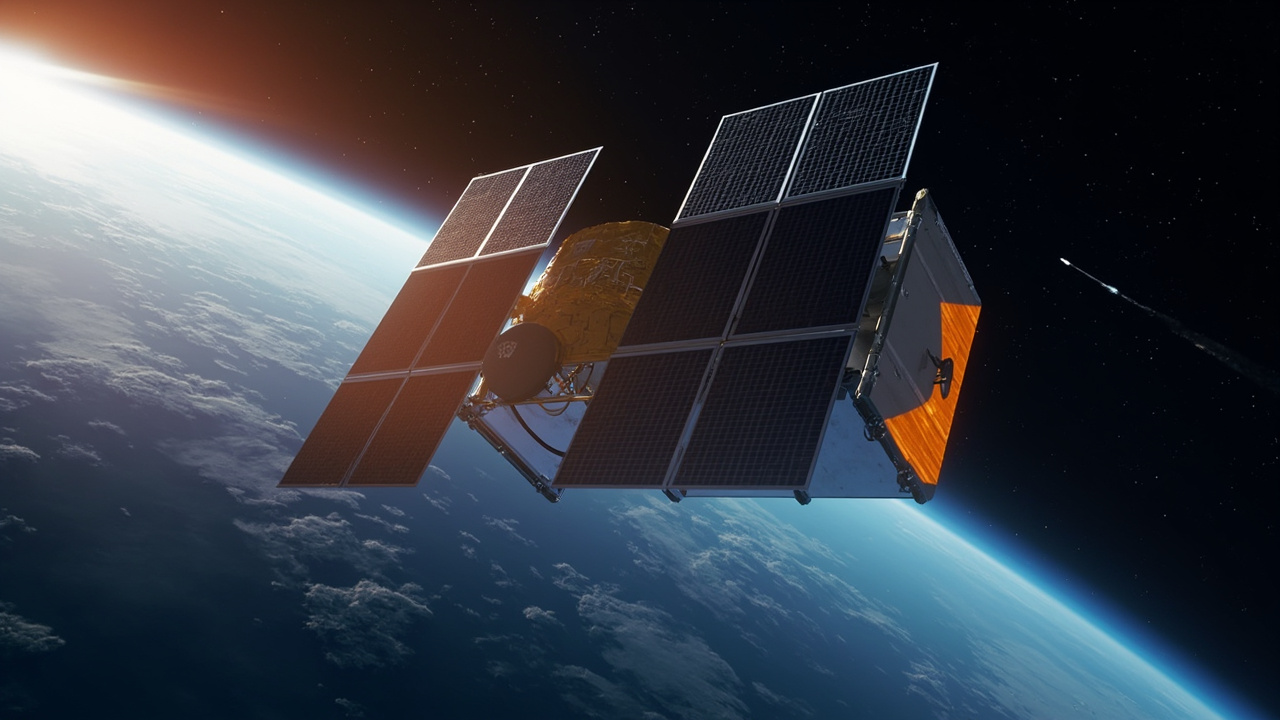
Google calls the spacecraft an MVP prototype. It is described as roughly the size of a refrigerator, according to Ars Technica. The structure itself was not built entirely by Google. The bus, or basic satellite platform, comes from San Francisco-based Earth-imaging company Planet, which partnered with Google to integrate the AI payload for this early check.
Inside that Planet platform are four Google TPUs, the application-specific circuits Google uses in terrestrial facilities to train models and run inference for token generation. A terrestrial AI facility may operate thousands of such accelerators. This orbital test carries only four, emphasizing validation over capacity.
Power supply is correspondingly modest. The prototype's solar arrays deliver about one kilowatt, enough for a household microwave or hair dryer, as reported by The New York Times and noted by Ars Technica. That figure underscores the experimental nature of the mission: the aim is to observe chip behavior under real orbital conditions, not to deliver commercial computing services.
Google originally considered waiting until 2027 to fly two custom-built satellites, but elected to move faster by placing its hardware inside an already developed Planet spacecraft, according to Ars Technica. The change pulled the first in-space data collection forward by more than a year.
Why space appeals for AI power
Data centers supporting modern AI consume large amounts of electricity, and local grid limits plus community opposition have complicated new construction in some regions. Orbital advocates contend that continuous sunshine in low Earth orbit could ease power constraints while removing facilities from populated neighborhoods.
Reuters reported that SpaceX and Starcloud are among other firms pursuing low Earth orbit computing concepts for similar reasons, seeking to use steady solar input for energy-intensive processing and to avoid terrestrial electricity bottlenecks. Google's update makes a parallel argument, pointing to near-constant illumination and the theoretical ability to connect multiple satellite groups into a larger processing network.
No participant has demonstrated large-scale orbital AI computing. Google explicitly describes Suncatcher as exploratory, with years of work still required before any judgment about practicality, cost or scale. The October flight is intended to supply initial measurements rather than to prove economic viability.
Surviving launch vibration and radiation
A ride to low Earth orbit lasts roughly 10 minutes, yet subjects payloads to strong shaking and sustained acceleration that can reach 10 times Earth's gravity, according to Google's Project Suncatcher update. Individual parts such as TPU chips can feel amplified shocks of 50 to 100 g because of how vibration moves through structures.
To simulate that environment, engineers mounted the satellite on a shaker table and vibrated it along all three axes at frequencies intended to mimic a rocket ascent. Google said the team was surprised in a positive way when the hardware remained intact, noting that such evaluations seldom proceed without problems.
Radiation presents a longer exposure. Outside atmospheric shielding, solar outbursts and cosmic rays can degrade electronics or alter calculations by flipping stored bits. Google ran AI workloads on TPUs inside a proton-beam facility at the University of California, Davis Crocker Nuclear Laboratory, watching for errors including bitflips.
Initial findings indicated that the company's Trillium-generation TPUs tolerated a total ionizing dose larger than the dose expected during a five-year mission, according to Google's Project Suncatcher update. Ground irradiation cannot reproduce every orbital effect, however, which is why the company says certain questions can only be answered by operating the chips in space for an extended interval.
Ars Technica noted that the TPUs flying on MVP are the same type of processors Google installs in ground servers, rather than specialized radiation-hardened space electronics. That choice increases uncertainty but also increases relevance: if standard AI accelerators can function adequately in orbit, future designs could avoid costly redesigns. Past uses of conventional hardware in space, including the Ingenuity Mars helicopter, have shown that commercial components can sometimes endure conditions beyond their original specifications.
Cooling may be the hardest problem
Removing waste heat is widely viewed as the most difficult obstacle for orbital computing. TPUs concentrate substantial heat in a small footprint. On Earth, fans and liquid loops move that heat into air or water. In vacuum, there is no air to carry heat away, leaving radiation to space as the only passive path.
Google said it is pursuing heat pipes paired with radiators, an approach already common on spacecraft but not previously applied at AI-accelerator power densities. Laboratory work has included testing inside a thermal vacuum chamber that reproduces both low pressure and temperature swings encountered in orbit.
The mechanical design described by Ars Technica uses a pliable thermal interface layer to link the chips to aluminum and copper heat pipes, which then conduct energy outward to a radiator that emits it away from the vehicle. The arrangement must remain stable through launch vibration while maintaining intimate contact for conduction.
Operational limits will be strict. Google plans to run Gemini models on the orbital TPUs in bursts of about 15 minutes, after which the chips must power down while radiators discharge accumulated heat, according to Ars Technica. The prototype is expected to remain in service for only a few months, providing repeated heating and cooling cycles across changing sunlight and shadow.
That brief duty cycle means the satellite will not function like a commercial data center. Instead, engineers will compare predicted thermal behavior with actual temperatures, power draw and workload accuracy, then revise radiator sizing, materials and control software for later spacecraft.
Lasers, clusters and the 2027 follow-up
If individual satellites can host AI chips, the next requirement is connecting them. Google envisions future spacecraft each carrying dozens of TPUs and flying in coordinated clusters. Workloads too large for one vehicle would be split across neighbors, demanding rapid, reliable links between fast-moving platforms.
The chosen method is laser communication. Space-based optical links already exist, but Google said most current systems prioritize modest data rates over very long distances. Suncatcher needs the opposite: very high throughput over relatively short satellite-to-satellite separations, with continuous tracking as both endpoints travel at orbital velocity.
Google likened the pointing challenge to striking a coin-sized target from miles away while both shooter and target remain in motion, according to Google's Project Suncatcher update. Position knowledge must therefore be precise, and acquisition and tracking must persist through vibration, thermal distortion and orbital dynamics.
A dedicated test of that capability is planned for 2027, when Google intends to place two satellites in orbit to exercise inter-spacecraft links. Those two spacecraft will also be built by Planet, according to Space.com, citing The New York Times. Data from the October prototype on power stability, thermal control and radiation-induced errors will feed directly into that two-vehicle design.
Google stresses that even successful laser tests would not create a product. The company says Suncatcher will require years to progress from project to product, if it ever does, according to Ars Technica. Each flight is framed as a chance to identify failures, adjust designs and decide whether a larger constellation merits further investment.
What happens next
For now, attention shifts to final integration and the Transporter-18 countdown. The launch remains scheduled, not completed, with Oct. 1 as the current target date reported across the Sept. 24 announcements. Delays are common for rideshare missions, where scheduling depends on the primary manifest, weather and range availability.
After deployment, Google will monitor TPU operation, radiation effects and heat rejection while running limited AI tasks. Results will inform the 2027 dual-satellite mission and longer-term judgments about orbital AI infrastructure. Whether sunshine, vacuum and weightlessness ultimately favor computing in space, or whether cooling, radiation and communications costs keep AI on the ground, will depend on measurements that have yet to be collected.
Sources referenced
- Google's first Suncatcher orbital data center test launches October 1 - Ars Technica (https://arstechnica.com/google/2026/09/googles-first-suncatcher-orbital-data-center-test-launches-october-1/)
- Learn about Google’s Project Suncatcher to put ML infrastructure in space (https://blog.google/innovation-and-ai/models-and-research/google-research/google-project-suncatcher-facts/)