TL;DR: NASA's $4.3 billion Nancy Grace Roman Space Telescope launched August 30, 2026, on a SpaceX Falcon Heavy to map dark energy, dark matter and exoplanets with a 100-times-Hubble view.
A flagship leaves Florida
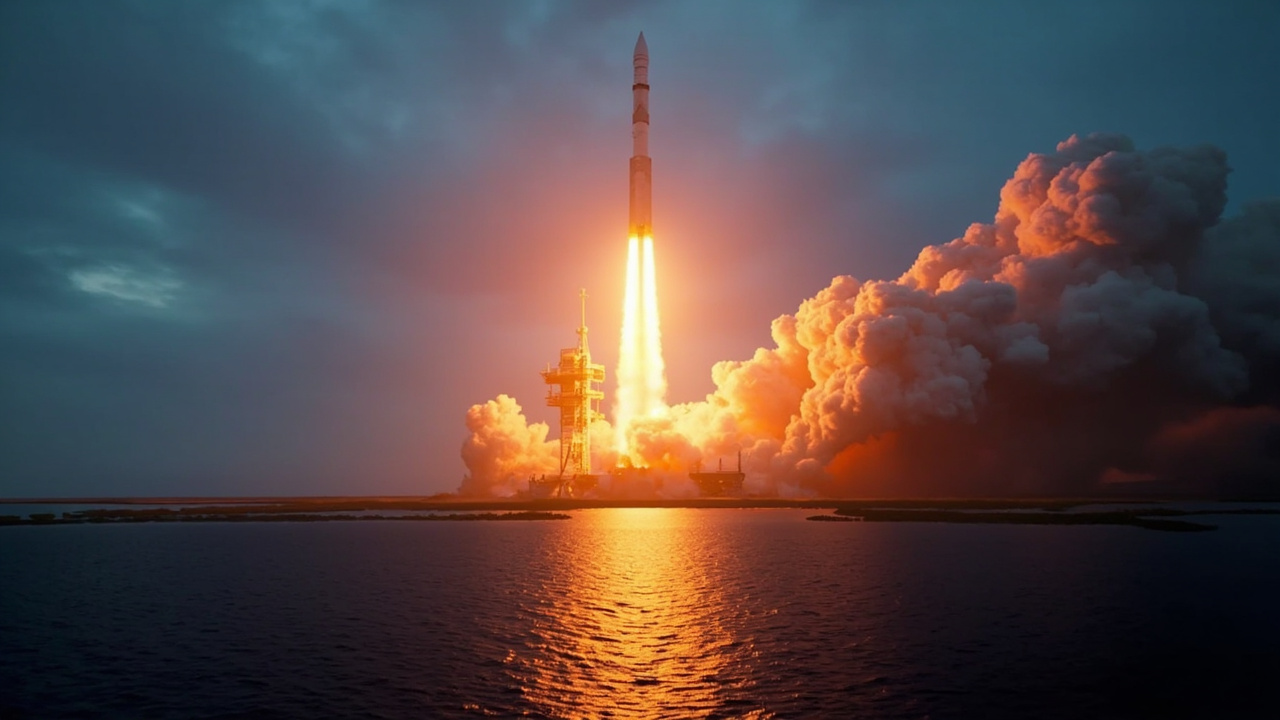
NASA's Nancy Grace Roman Space Telescope launched Sunday from Kennedy Space Center in Florida on a mission to reveal the mysterious forces driving the Universe, according to Ars Technica.
A SpaceX Falcon Heavy rocket provided the lift from Launch Complex 39A at NASA's Kennedy Space Center in Florida, according to NASA's Jet Propulsion Laboratory (JPL). JPL reported liftoff at 7:26 a.m. EDT Sunday, Aug. 30, 2026, while Ars Technica reported takeoff at 7:25 a.m. EDT (11:25 UTC) Sunday from the same pad.
The heavy-lifter is powered by 27 kerosene-fueled main engines, according to Ars Technica. The vehicle flew downrange over the Atlantic Ocean and released its two reusable side boosters to return to Cape Canaveral, according to Ars Technica. JPL reported that after separating from the center core, the rocket's boosters safely returned to the launch site for refurbishment.
Fully fueled, Roman tipped the scales at some 20,000 pounds (9 metric tons) and filled the Falcon Heavy's payload fairing, according to Ars Technica. NASA launch director Denton Gibson said the team needed all of the vehicle's thrust for the heavy observatory, and described the Falcon Heavy performance as flawless, according to Ars Technica. JPL reported that the Falcon Heavy rocket performed as expected, separating from the observatory 31 minutes into the flight.
The ground control team at NASA's Goddard Space Flight Center in Greenbelt, Maryland, began receiving telemetry data from Roman seven minutes after launch, according to JPL.
Where Roman is going
The rocket sent the observatory toward an observation post around the Sun-Earth L2 Lagrange point, a gravitational balance point nearly a million miles (1.5 million kilometers) from Earth, according to Ars Technica.
The Planetary Society described the destination as Sun-Earth Lagrange Point 2, about 1.5 million kilometers (930,000 miles) away. NASA Science explained that Roman will orbit 1 million miles away at the second Sun-Earth Lagrange point (L2), the same location as NASA's James Webb Space Telescope.
At L2, gravity from the Sun and Earth works together with an object's motion around the Sun to hold it roughly in place, giving Roman a relatively steady orbit without using much fuel, according to NASA Science. Like Webb, Roman will trace out a large orbit around the actual L2 point — much larger than the Moon's orbit around Earth — and the two will easily be kept far apart, according to NASA Science.
Ars Technica reported that Roman was deployed on a course to take it four times farther from Earth than the Moon. It will take about three months for Roman to reach its operational orbit around the L2 point, according to Ars Technica. JPL described the trip as a three-month, million-mile journey to its final orbit.
First steps after separation
The Roman team also confirmed successful deployment of the observatory's solar panels and lower instrument sun shade an hour and 23 minutes after launch, according to JPL.
Within the upcoming days, Roman's high-gain antenna and visor-like deployable aperture cover will deploy, ground controllers will initiate the first of two mid-course corrections, and the Coronagraph Instrument will power on, according to JPL.
Ground teams will activate and calibrate the observatory during the transit, and scientists aim to have the first science images ready for publication by the end of the year, according to Ars Technica.
Ahead of schedule and on budget
Roman is just the second NASA-led astrophysics mission to launch this century, following the launch of Webb in 2021, according to Ars Technica.
Unlike Webb, which suffered many years of delays before reaching space, Roman arrived at the launch pad nine months before NASA's commitment to send it skyward by May 2027, according to Ars Technica.
"Roman is exactly the kind of success story we want to see across NASA," NASA Administrator Jared Isaacman said, according to Ars Technica. Isaacman said the mission was delivered ahead of schedule and on budget and reflected more than a decade of dedication from the NASA workforce and industry partners, according to Ars Technica. He said Roman will give the agency a new atlas of the Universe, push the boundaries of discovery, and demonstrate what is possible when America's space program pairs bold ambition with disciplined execution, according to Ars Technica.
Roman passed its NASA confirmation review in 2020, and since then, the mission's development has proceeded on budget and faster than expected, according to Ars Technica.
A spy mirror turned to the stars
NASA named the mission after Nancy Grace Roman, the agency's first chief astronomer and a pioneering advocate of space-based telescopes, according to Ars Technica. During her tenure at NASA, Roman fostered support in the science community and funding from Congress for what became Hubble, according to Ars Technica. Roman retired from her position in NASA's leadership in 1979 and died in 2018, according to Ars Technica.
NASA announced in 2020 that the next great observatory, up until then known as the Wide Field Infrared Survey Telescope (WFIRST), would be named in honor of Roman, according to Ars Technica. NASA Science reported that Roman is named after Dr. Nancy Grace Roman (1925–2018), NASA's first chief of astronomy, who championed space-based observatories that could study the universe above Earth's hazy atmosphere while making their data broadly available.
Engineers spent the better part of a decade assembling the observatory around a 7.9-foot-diameter (2.4-meter) telescope donated to NASA by the National Reconnaissance Office, the U.S. government's spy satellite agency, according to Ars Technica. The telescope's primary mirror is the same size as that of Hubble, according to Ars Technica.
NASA took possession of two NRO spy telescopes in 2012, and scientists soon earmarked one of them for the mission that became Roman, according to Ars Technica. The NRO declared the telescopes surplus after the cancellation of one of its surveillance satellite programs, according to Ars Technica. The agency hasn't identified a use for the second telescope, according to Ars Technica.
The sudden availability of an off-the-shelf telescope led to a redesign of WFIRST, according to Ars Technica. The observatory — still on the drawing board at the time — essentially doubled in size to accommodate the telescope, improving its vision while adding to its cost, according to Ars Technica. Ground teams also had to reconfigure the mirror to change its "optical prescription" and accommodate colder operating temperatures, according to Ars Technica.
"It certainly wasn't just plug and play," said Julie McEnery, senior project scientist for the Roman telescope at NASA's Goddard Space Flight Center, according to Ars Technica.
Why the view is 100 times wider
The new mission will extend the vision of NASA's other famous observatories, providing a field of view 100 times wider than the Hubble Space Telescope and complementing the groundbreaking work of the James Webb Space Telescope, according to Ars Technica.
The observatory's Wide Field Instrument is a 300-megapixel infrared camera that will give Roman the same sharpness as Hubble but with a field of view at least 100 times larger, according to NASA Science. Using this instrument, each Roman image will capture a patch of the sky about 1.5 times bigger than the apparent size of a full Moon, according to NASA Science.
Nicky Fox, head of NASA's Science Mission Directorate, calls Roman the Swiss Army knife of telescopes, according to Ars Technica. It will survey 12 percent of the sky, while Hubble observed 0.1 percent over its 36 years in orbit, according to Ars Technica.
Roman pairs a large field of view with crisp infrared vision to explore vast swaths of the sky and probe deeply into cosmic history, according to JPL. This flagship mission will help astronomers explore dark matter, dark energy, and worlds outside of our solar system, known as exoplanets, according to JPL. Its surveys will support a broad range of research extending far beyond the mission's main science goals, according to JPL.
NASA Science reported that Roman will pair a large field of view with crisp infrared vision to scan vast, deep swaths of sky. Roman's data will be made public as soon as it's processed, allowing many teams to analyze it simultaneously, according to NASA Science.
Hunting dark energy, dark matter and planets
Roman will investigate dark energy, which scientists identified decades ago as a mysterious phenomenon causing the accelerated expansion of the Universe, according to The Planetary Society. By conducting a massive survey of over 1 billion galaxies, Roman will narrow the search by mapping the structure of the Cosmos through space and time, according to The Planetary Society.
The survey will also help researchers probe dark matter, described as something additional needed to explain how galaxies move and how the Universe has evolved over time, according to The Planetary Society. Many researchers argue dark matter is likely to be a substance that does not interact with light, according to The Planetary Society.
The U.S. astronomical community rated Roman the highest-priority large space mission of the 2010s, according to The Planetary Society.
On planets, Roman is expected to discover thousands of worlds beyond the Solar System, while humanity has confirmed about 6,000 such worlds over the past few decades, according to The Planetary Society. The mission will also take direct photographs of planets and explore some of their atmospheres, as well as find potentially Earth-like worlds around other stars, according to The Planetary Society.
Scientists predict Roman will detect somewhere within the range of 60,000-200,000 candidate planets using the transit method, which involves watching stars dim as orbiting planets pass in front of them, according to The Planetary Society. Only a small fraction of these candidate worlds will be able to be confirmed, according to The Planetary Society. Roman is also expected to discover thousands of planets using a technique called microlensing, according to The Planetary Society.
Other predicted yields include hundreds of rogue planets that orbit no star, including some worlds as small as Mars, dozens of planets orbiting in the habitable zones of their stars, 80,000 Type Ia supernovae, and up to nearly 100,000 cosmic voids, according to The Planetary Society.
A coronagraph test for future Earth-hunters
The spacecraft will study the mysteries of the cosmos while also testing the Coronagraph Instrument, designed and built by JPL to demonstrate advanced hardware for studying planets around other stars, according to JPL.
Roman's Coronagraph Instrument is designed to demonstrate the most advanced technologies ever flown in space for directly imaging planets around other stars, according to NASA Science. It will block the glare from stars and make it possible for scientists to see the faint reflected light from planets in orbit around them, revealing giant worlds that are older, colder, and in closer orbits than the hot, young super-Jupiters direct imaging has mainly revealed so far, according to NASA Science.
This instrument will demonstrate the technology that future missions like NASA's Habitable Worlds Observatory concept could use to image Earth-like planets in the search for life in the universe, according to JPL. Roman's Coronagraph will take a giant step in that direction by snapping pictures of Jupiter-like planets, according to JPL.
How long Roman will work
Roman will have a primary mission lifetime of five years and is designed to support an additional five-year extended mission, according to NASA Science. Fuel is expected to be the mission's life-limiting resource, and while NASA does not currently have an ability to service observatories at L2, Roman is designed to be refuelable, according to NASA Science.
The spacecraft carries the names of more than a million people, according to NASA Science. Everyone was invited to submit their name to be added to a memory card attached to a plaque on the Roman spacecraft, and more than 1.3 million people did so and will have their names carried all the way to L2, according to NASA Science.
Sources referenced
- NASA's next "great observatory" begins mission to widen our view of the Universe - Ars Technica (https://arstechnica.com/space/2026/08/nasas-next-great-observatory-begins-mission-to-widen-our-view-of-the-universe/)
- NASA’s Dark Universe-Seeking Nancy Grace Roman Space Telescope Launches | NASA Jet Propulsion Laboratory (JPL) (https://www.jpl.nasa.gov/news/nasas-dark-universe-seeking-nancy-grace-roman-space-telescope-launches/)