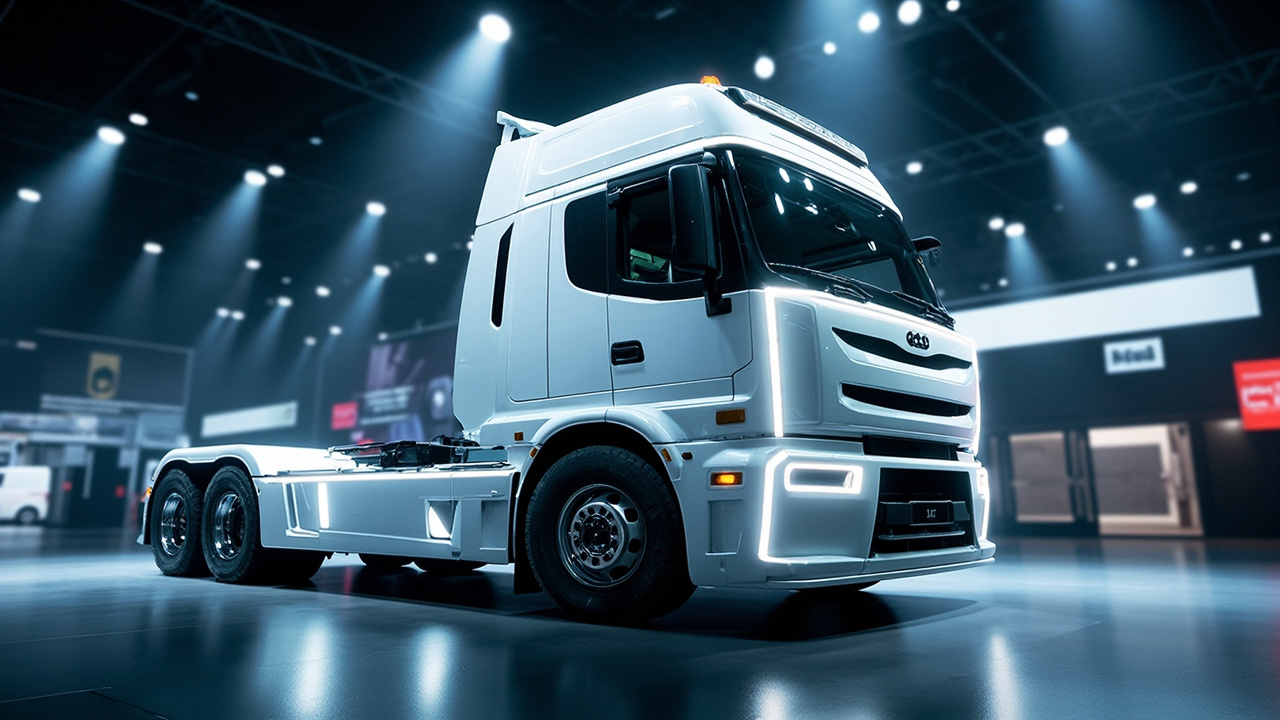
TL;DR: Pony.ai unveiled a Level 4 autonomous heavy-duty truck built with GAC Commercial Vehicle at IAA Transportation 2026 in Hannover on September 14, 2026, with volume production scheduled for later in 2026 and Europe entry planned within two years.
Unveiling in Hannover answers what is new
Pony AI Inc. introduced a new Level 4 autonomous heavy-duty truck on September 14, 2026, at IAA Transportation 2026 in Hannover, Germany, according to the company announcement distributed by PR Newswire.
The vehicle was developed together with GAC Commercial Vehicle and represents one entry in Pony.ai's fourth-generation Robotruck lineup, according to the same announcement.
The presentation was described as a global debut and as a step toward mass production and commercial deployment of the Gen-4 Robotruck platform, according to the company announcement distributed by PR Newswire.
Pony.ai trades as NASDAQ: PONY and HKEX: 2026, according to the company announcement distributed by PR Newswire.
The Hannover event also included GAC Commercial Vehicle's first appearance at IAA Transportation under the theme "Delivering the Future Together," according to a separate GAC Commercial Vehicle announcement distributed by PR Newswire.
That GAC Commercial Vehicle announcement said its display covered new-energy heavy and light commercial vehicle products, technologies and ecosystem activities.
Platform is battery-electric T9 for freight uses
The new autonomous model uses GAC Commercial Vehicle's T9 battery-electric heavy-duty truck platform, according to the company announcement distributed by PR Newswire.
Volume production is scheduled to begin later this year, according to the company announcement distributed by PR Newswire.
The intended deployments named for the vehicle are long-haul freight, dedicated-route logistics and port transportation, according to the company announcement distributed by PR Newswire.
Automotive World, in independent trade-press coverage of the same IAA debut, likewise listed long-haul freight, port operations and dedicated-route logistics as the planned deployment areas.
The approach focuses on repeatable freight tasks rather than unspecified general trucking, based on the three use categories named by the company.
Port transportation and dedicated routes involve fixed infrastructure and recurring movements between defined points, as reflected in the use cases identified in the announcements.
Long-haul freight involves extended intercity movement of goods, as reflected in the category named in the announcements.
No customer deliveries, fleet orders, prices or commercial service dates for the T9 autonomous model were disclosed in the company announcement distributed by PR Newswire.
Redundant chassis and shared autonomy stack
The truck combines Pony.ai's Gen-4 Level 4 autonomous trucking system with a fully redundant drive-by-wire chassis from GAC Commercial Vehicle, according to the company announcement distributed by PR Newswire.
Steering, braking, communications, power supply, computing and sensing systems use fully redundant architectures, according to the company announcement distributed by PR Newswire.
The redundant design is intended to support safe operation across a wide range of conditions, according to the company announcement distributed by PR Newswire.
Automotive World likewise reported redundant architectures across braking, steering, power supply, communications, computing and sensing.
The autonomy implementation uses Pony.ai's vehicle-agnostic Virtual Driver technology, described as full-stack software, hardware and services, according to the company announcement distributed by PR Newswire.
The same underlying Virtual Driver technology is applied across Robotaxis, heavy-duty trucks and light-duty trucks, according to the company announcement distributed by PR Newswire.
Fully redundant safety architectures support that cross-vehicle approach, according to the company announcement distributed by PR Newswire.
The shared approach means development work on the core driving system can apply to more than one vehicle type, based on the company's description of one underlying system across Robotaxis and trucks.
Sensors, controller and 360-degree coverage
The vehicle carries a fully automotive-grade autonomous driving kit, according to the company announcement distributed by PR Newswire.
The kit comprises nine lidars, three millimeter-wave radars and 13 cameras, according to the company announcement distributed by PR Newswire.
The sensor arrangement provides 360-degree sensing coverage with no blind spots, according to the company announcement distributed by PR Newswire.
Automotive World independently listed the same sensor counts of nine lidars, three millimetre-wave radars and 13 cameras and the same 360-degree coverage description.
The truck uses the same domain controller as Pony.ai's seventh-generation Robotaxis, according to the company announcement distributed by PR Newswire.
That common controller links the heavy-duty truck program to the company's passenger-vehicle autonomy program at the computing-hardware level.
Standardizing the controller can simplify development, maintenance and parts supply across vehicle classes, based on the common-hardware fact stated by the company.
The sensor total is 25 devices when the nine lidars, three radars and 13 cameras are added together, based on arithmetic applied to the disclosed counts.
Cost and energy figures are company expectations
The bill-of-materials cost of the autonomous driving kit has been reduced by 70% compared with the previous generation, according to the company announcement distributed by PR Newswire.
Transportation costs per ton-kilometer are expected to fall by 30%, according to the company announcement distributed by PR Newswire.
Automotive World reported the same 70% kit-cost reduction and the same projected 30% reduction in per-tonne-kilometre transport costs.
GAC Commercial Vehicle's separate announcement likewise said hardware costs were 70% lower than the previous generation and autonomous-driving transportation cost per ton-kilometer was approximately 30% lower.
The 30% transport-cost figure is an expectation or projection, not a reported operating result from deployed service, according to the wording in the company announcement distributed by PR Newswire.
The 70% figure applies to the autonomous driving kit bill of materials, not to the price of the complete truck, according to the wording in the company announcement distributed by PR Newswire.
Pony.ai's energy-efficiency algorithms, combined with the T9's drag coefficient of 0.4 Cd, are expected to reduce energy consumption by 10% compared with conventional trucks, according to the company announcement distributed by PR Newswire.
Automotive World likewise reported a Cd of 0.4 and an expected 10% energy-consumption reduction against conventional trucks when combined with Pony.ai's efficiency algorithms.
The T9 was described as having an ultra-low drag coefficient of 0.4 Cd, according to the company announcement distributed by PR Newswire.
The stated purpose is smarter, greener and more efficient freight operations, according to the company announcement distributed by PR Newswire.
From April agreement to September debut
The new model extends a longstanding partnership between Pony.ai and GAC Group from Robotaxi work into Robotruck work, according to the company announcement distributed by PR Newswire.
Pony.ai and GAC Commercial Vehicle signed a strategic cooperation agreement on April 16, according to the company announcement distributed by PR Newswire.
Within five months, the companies completed vehicle testing and validation before the formal launch, according to the company announcement distributed by PR Newswire.
Automotive World reported that the cooperation agreement signed on 16 April 2026 enabled testing and validation within five months.
The company attributed the pace to Pony.ai's autonomous-driving expertise together with GAC Commercial Vehicle's automotive engineering and manufacturing capabilities, according to the company announcement distributed by PR Newswire.
Pony.ai Vice President and Robotruck business head He Xing said the debut marked another step toward accelerating mass production and commercial deployment, according to the company announcement distributed by PR Newswire.
He Xing also said the companies would deepen collaboration and bring jointly developed autonomous trucking solutions to markets around the world, according to the company announcement distributed by PR Newswire.
Europe and Middle East remain planned, not started
Pony.ai plans to expand its Robotruck business internationally, including entering markets in Europe and the Middle East over the next two years, according to the company announcement distributed by PR Newswire.
That timetable points to possible entry by September 2028 if measured as two years from the September 2026 announcement, based on arithmetic applied to the disclosed period.
The international approach is intended to build on technology, commercial experience and a partner-led method developed through operations in China, according to the company announcement distributed by PR Newswire.
It is also intended to use overseas operating experience from the Robotaxi business, according to the company announcement distributed by PR Newswire.
Pony.ai currently has Robotaxi operations and partnerships underway in the UAE, Qatar, Croatia, Luxembourg, Singapore and South Korea, according to the company announcement distributed by PR Newswire.
Automotive World listed the same six international Robotaxi markets: Singapore, South Korea, the UAE, Qatar, Croatia and Luxembourg.
No European Robotruck customer, order, price, test location or commercial-service date was named in the company announcement distributed by PR Newswire.
The September 14 communications therefore document a vehicle unveiling plus future production and market-entry plans, not the start of European sales or deliveries.
Company history and product scope
Pony.ai began developing Robotrucks in 2018 and has built a portfolio spanning heavy- and light-duty trucks, according to the company announcement distributed by PR Newswire.
The company is advancing Gen-4 Robotrucks toward mass production while working with vehicle manufacturers and logistics operators, according to the company announcement distributed by PR Newswire.
The logistics segments named are long-haul freight, bulk commodity transportation, port logistics and urban delivery, according to the company announcement distributed by PR Newswire.
Pony.ai was founded in 2016 and has expanded across China, Europe, Asia, the Middle East and other regions, according to the company announcement distributed by PR Newswire.
GAC Commercial Vehicle said it draws on nearly two decades of commercial-vehicle expertise in research, manufacturing and quality management developed through the GAC Hino joint-venture system, according to the GAC Commercial Vehicle announcement distributed by PR Newswire.
GAC Commercial Vehicle reported sales growth of 205% year-on-year in the first half of 2026, according to the GAC Commercial Vehicle announcement distributed by PR Newswire.
It also cited access to GAC Group sales and service networks across 110 countries and regions, according to the GAC Commercial Vehicle announcement distributed by PR Newswire.
Sources referenced
- Pony.ai Unveils New Gen-4 Robotruck in Collaboration with GAC Commercial Vehicle (https://www.prnewswire.com/news-releases/ponyai-unveils-new-gen-4-robotruck-in-collaboration-with-gac-commercial-vehicle-302877606.html)
- Pony.ai and GAC unveil Gen-4 Level 4 Robotruck at IAA 2026 | Automotive World (https://www.automotiveworld.com/news/pony-ai-and-gac-unveil-gen-4-level-4-robotruck-at-iaa-2026/)